



The Federal Reserve cut interest rates for the first time in four years on Wednesday. Let’s take a look at how stocks performed at the start of previous easing cycles. According to historical data, future performance will largely depend on the state of the economy. Overall, in various cycles, the performance of the S&P 500 after the first rate cut was mostly positive, though there were significant drops when the economy entered a downturn. The index rose in 70% of cases after three and six months, and in 80% of cases a year later, according to Canaccord Genuity, which analyzed the last 10 easing cycles, starting from 1970.
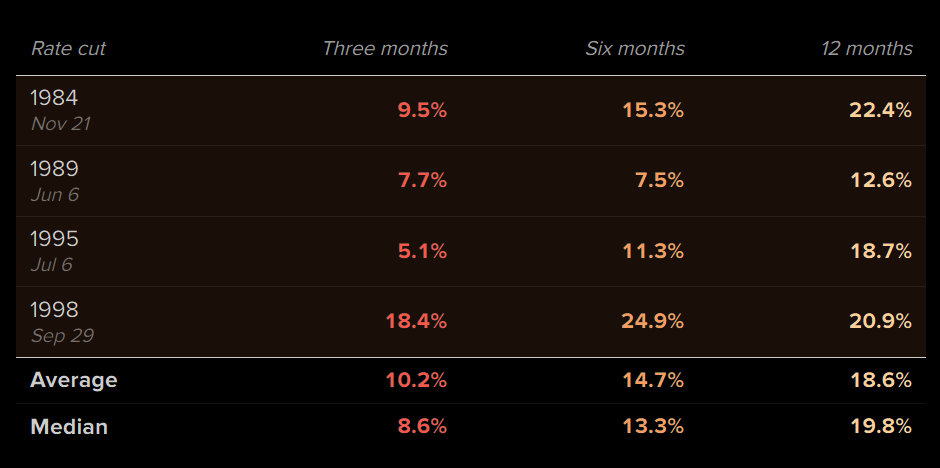
On average, the S&P 500 increased by 5.5% in the first three months after the initial cut, by 10.6% after six months, and by 11.3% a year later. However, if we exclude cases where a recession followed and calculate only in “soft landing” scenarios—such as the current consensus—the performance is even better. Canaccord defines a recessionary scenario as one in which the economy is already in decline or enters a decline within 12 months of the first rate cut. In years when the S&P 500 did not experience a recession during or soon after the first cut—such as in 1984, 1989, 1995, and 1998—the index rose in 100% of cases after three, six, and 12 months. On average, the index rose by 10.2% after three months, by 14.7% after six months, and by 18.6% a year later.
Other investment banks also note this difference, with Bank of America Securities highlighting the pattern in a recent report. “The easing cycle itself isn’t necessarily positive. In fact, [the S&P 500] showed weaker performance on average after the first rate cuts, but with clear differences depending on the state of the economy,” Osang Kwon of the firm wrote on Monday. The S&P 500 “only rose in 20% of cases over 100 trading days following the first cuts when there was a recession within six months, but in 100% of cases when there was no recession (an average of +8%),” she noted. By sector, Canaccord Genuity highlights that the three sectors with the best average returns a year later are communication services, information technology, and healthcare. The worst-performing sectors 12 months after rate cuts are materials, utilities, and consumer goods.
Varchev Absolute Trader
борсова платформа
- Търгувай над 3000 финансови инструмента: Crypto, Форекс, Акции, Индекси, Суровини, ETF-и
- Използвай платформа с директно изпращане ордерите на борсите
- Cloud base платформа - твоят трейдинг сетъп на всяко устройство
- Market Sentiment - търгувай с настроенията на инвестиционите банки
- Top movers - най-горещите трейдове във всеки един момент
- Stocks scanner - филтрирай най-подходящите за твоя трейдинг стил пазарни инструменти
- Heat map - Търгувай в посоката на големите играчи
Meta Trader 5
- Търгувай Crypto, Форекс, Акции, Индекси, Суровини - всичко на едно място
- Автоматизирана търговия с интелигентни стратегии и роботи (Expert Advisors)
- Разширен технически анализ с хиляди индикатора и инструменти
- Сигурност и стабилност – платформа, доверена от милиони по света
- Нулев марджин при насрещни/хеджирани позиции
- Без комисиона при търговия със CFDs
- Светкавично изпълнение на сделките
Read more:


Login to comment
Comments:
Leave a comment