


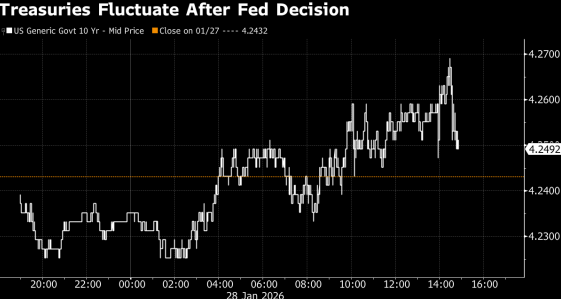
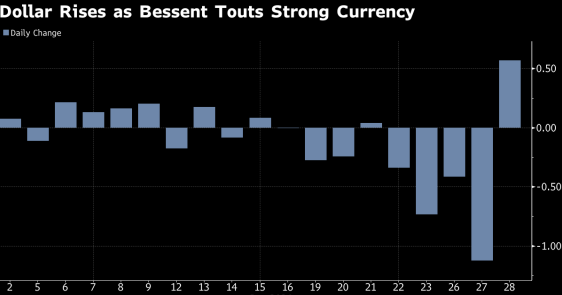
The Federal Reserve’s decision to leave interest rates unchanged led to choppy trading in stocks and bonds after Chair Jerome Powell refrained from signaling a near-term resumption of rate cuts amid a stable economic backdrop. The U.S. dollar strengthened after U.S. Treasury Secretary Scott Bessent emphasized the importance of a strong currency.
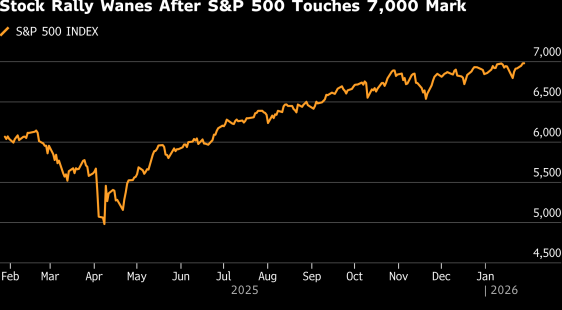
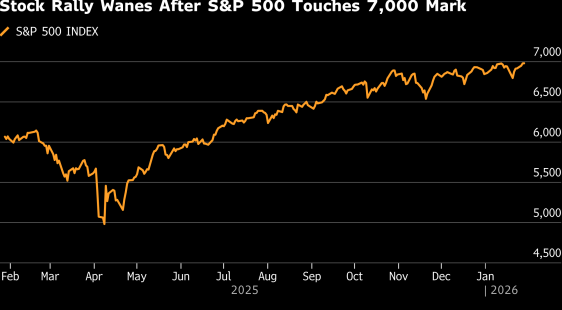
The bond market remains largely unchanged. After a technology-led rally briefly pushed the S&P 500 above the 7,000 level, equity gains faded. Investors are turning their attention to results from mega-cap companies, seeking guidance on the outlook for artificial intelligence–related trading. Additional signals are expected later today with earnings reports from Microsoft and Meta Platforms.
Markets are closely parsing the Fed’s messaging. Central bank officials pointed to improving economic conditions and signaled a more cautious approach. The Federal Open Market Committee voted 10–2 to keep the federal funds rate in the 3.5%–3.75% range. Governors Christopher Waller and Steven Miran dissented, favoring a 25-basis-point rate cut.
Powell highlighted “clear improvement” in the economic outlook for the coming year and noted that the labor market is stabilizing. At the same time, he said long-term inflation expectations remain anchored, even as higher prices in the near term reflect the impact of tariffs.
“The Fed’s tune remains the same — rate cuts are possible, but investors will need patience,” said Ellen Zentner of Morgan Stanley Wealth Management. In her view, labor market stabilization and contained inflation give the central bank room to wait and observe developments.
The limited number of dissents underscores how strong the consensus within the Fed remains. That means any new chair following Powell’s term is likely to face challenges convincing others that rates should be significantly lower, according to Sonu Varghese of Carson Group.
According to Kay Ha of Goldman Sachs Asset Management, the Federal Reserve is likely to maintain a longer pause, as strong economic activity data and labor market stabilization reduce the need for additional stimulus. She still expects easing to resume later in the year if inflation cools, with two additional “normalizing” rate cuts.
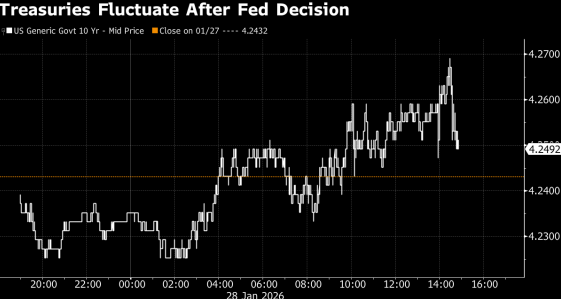
From a market perspective, the S&P 500 is little changed. Yields on 10-year U.S. Treasurys are holding near 4.25%. The dollar is up 0.5%. Bessent told CNBC that the U.S. has not intervened to support the yen, sending the Japanese currency down nearly 1%. Gold climbed above $5,300 per ounce.
The Federal Reserve’s statement upgraded its assessment of economic growth from “moderate” to “solid,” effectively embracing the view that the underlying pace of activity accelerated toward the end of 2025, noted Krishna Guha of Evercore. At the same time, the Fed said unemployment has “shown some signs of stabilization,” even as job growth remains subdued.
“The message is clear: the Fed is comfortable holding rates at 3.5%–3.75% and may stay there for some time while it confirms that the labor market is truly stabilizing, monitors the upcoming tariff-driven inflation peak, and assesses the impact of fiscal stimulus through forthcoming tax refunds,” Guha said. In his view, the statement aligns with his long-standing forecast that Powell is unlikely to cut rates again before stepping down as chair in May.
“Recent data continue to show an economy still running at a high level, with strength across multiple fronts,” said Seema Shah of Principal Asset Management. “And with unemployment unexpectedly falling last month, the Fed feels confident enough to remove references to downside risks. Still, the wave of high-profile layoffs suggests it is too early to declare victory.”
There is justification for a “wait-and-see” approach given the risk of a “second wave” of higher prices as tariff pass-through increases, noted Eric Teal of Comerica Wealth Management.
Given the Fed’s more likely view that the dual risks of inflation and unemployment are broadly balanced, no policy change should be expected at the March meeting, said Jeffrey Roach of LPL Financial. He anticipates the first rate cut later in the year, when inflation is likely to ease as housing pressures fade and companies work through tariff effects.
The change in the statement acknowledging solid economic growth and stabilizing unemployment is further evidence that the Fed is unlikely to cut rates for at least several more meetings, according to Stephen Brown of Capital Economics. Still, the two dissenting votes in favor of a 25-basis-point cut show that the inclination toward further easing remains, he added.
“Residual effects from potential distortions in economic data likely led the majority of voting Fed officials to pause and wait for more information,” said Luis Alvarado of Wells Fargo Investment Institute. “It also appears that the risk of inflation remaining at the upper end around 2% is a serious concern.”
In his view, the window for additional cuts, if policy remains truly data-dependent, may narrow as 2026 approaches. Still, given the many countervailing forces within the Fed’s voting composition, he sees potential for two more cuts later in 2026.
Although the Fed continues to describe inflation as “somewhat elevated,” the tone does not suggest urgency for another cut in the near term, according to Dan Siluk of Janus Henderson Investors.
“The dissenting votes with a more dovish tone from Governors Waller and Miran highlight ongoing internal division, but the majority is adopting a more patient, data-dependent stance, supported by stronger growth and early signs of labor market stability,” he said.
“Today’s decision is unlikely to materially change expectations for rate cuts in 2026,” said Jason Pride of Glenmede. “A reasonable base case is for one or two additional cuts, but that process will likely begin around midyear.”
This gives the Fed time to gather more data before confirming further progress on inflation and/or becoming sufficiently concerned about labor market deterioration, especially given that some official data sources are still influenced by the effects of last year’s government shutdown, Pride added.
“Real interest rates — the Fed’s policy rate adjusted for inflation — are likely still too high,” said Scott Helfstein of Global X. “That leads us to believe the Fed could prove more inclined to ease than the market expects and deliver another rate cut as early as the first quarter. In the meantime, markets are likely to be driven by fundamentals, and so far earnings season is meeting high expectations, with many companies reaffirming guidance.”
“The Fed has plenty of time to decide,” said David Russell of TradeStation. “Inflation remains above target, and jobless claims are low. Additional stimulus from tax refunds is also expected, so if there was ever a good time to wait, this was it. The committee has effectively split into two camps in the final months of Powell’s term — a larger group favoring a ‘wait-and-see’ approach, and a smaller, more dovish faction.”
According to Russell, this predictable statement allows investors to shift their focus from macroeconomic headlines to corporate earnings, which are likely to be the primary catalyst in the coming weeks.
As geopolitical noise temporarily fades — having distracted from what has otherwise been a relatively calm year for artificial intelligence so far — attention may soon return to the underlying fundamentals of technology and AI, said Jim Reid of Deutsche Bank.
Given ongoing valuation concerns, investors are entering the tech earnings season seeking clarity on AI demand and monetization, as well as guidance on capital spending, noted Ulrike Hoffmann-Burchardi of UBS Global Wealth Management.
Microsoft and Meta Platforms are the first of the four largest corporate AI investors in the U.S. to report, with results from Alphabet and Amazon due next week. This year alone, the group is expected to generate combined capital expenditures of around $505 billion, up from roughly $366 billion in 2025, according to Bloomberg data.
Any signal that companies plan to invest even more than expected in AI development could weigh on their shares while simultaneously supporting beneficiaries of that spending, such as chipmakers Nvidia, Broadcom, and Micron Technology.
“While higher capital spending is likely partially priced in, we expect revenue growth at cloud service providers to accelerate this quarter, and evidence that AI efforts are delivering results in terms of advertising engagement will also be viewed positively,” Hoffmann-Burchardi said. “We believe AI will remain a key driver of equity performance, with benefits expanding into intelligent solutions and applications.”
She expects U.S. equities to remain supported and forecasts the S&P 500 to reach 7,700 by year-end, with broader-based gains.
“We see opportunities in technology, healthcare, financials, utilities, and cyclical consumer sectors and recommend that investors with concentrated positions diversify their exposure,” she added.
After three consecutive years of double-digit returns concentrated in the largest AI-related companies, the market is starting the year with broader participation, led by energy, materials, and consumer staples, noted Chris Senyek of Wolfe Research.
Optimism that the U.S. economy is on the verge of acceleration is fueling this rotation, with companies closely tied to the economic cycle attracting investor capital. At the same time, AI investing within the tech sector is becoming less one-directional, as investors begin to differentiate winners from losers.
“The ‘market broadening’ trade pauses during mega-cap tech earnings,” Senyek said. “Our sense is that the combination of solid fourth-quarter results, lower valuations, and ongoing AI tailwinds will likely refocus investor interest on these companies.”
Absent a major macroeconomic or regulatory shock forcing a market reset, momentum in corporate earnings is likely to remain strong, with large technology companies continuing to drive the market narrative, according to Chris Brigati of SWBC.
“Large technology companies and the artificial intelligence theme continue to climb with impressive strength. Investors should maintain a constructive short-term growth outlook but also be realistic that the current pace will eventually cool,” he said.
According to Brigati, when that happens, disciplined stock selection will become critical. Long-term winners will be companies that execute flawlessly, protect margins, lead in innovation, and stay aligned with changing consumer behavior.
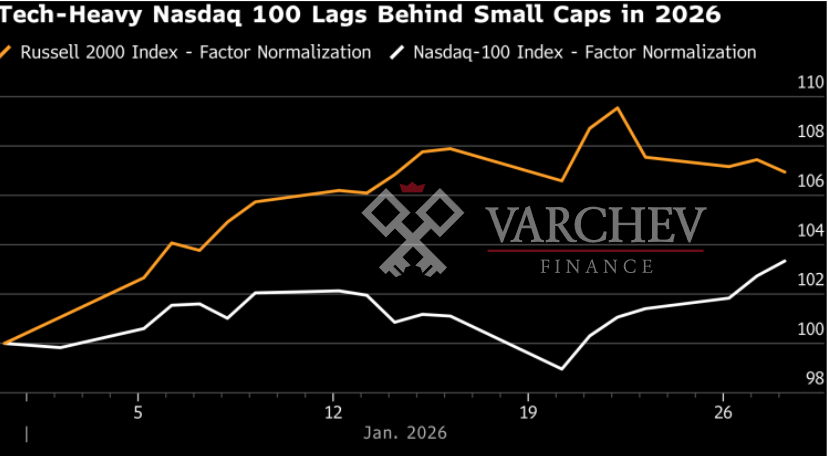
One concern for bullish sentiment is that the Nasdaq 100 has yet to “meaningfully” confirm the S&P 500’s new record highs, noted Matt Maley of Miller Tabak.
“If the Nasdaq 100 manages to break out to a convincing new high and confirm the peaks in the S&P 500 and Russell 2000, that would provide an additional boost to bullish sentiment into late January and February,” he said.
Corporate highlights:
– Texas Instruments delivers a surprisingly strong first-quarter outlook, signaling a recovery in demand for industrial equipment and automobiles.
– Amazon cuts 16,000 corporate positions to reduce bureaucracy and improve accountability, joining the latest wave of companies targeting management layers.
– ASML reports record fourth-quarter orders, despite questions over whether it can sustain AI-driven momentum.
– SK Hynix posts its strongest quarterly results on record, underscoring the scale of the AI wave and unprecedented growth in memory demand.
– Blackstone considers expanding its financial commitment to Oracle’s Michigan data center project.
– AT&T beats fourth-quarter earnings and revenue expectations, supported by customers using multiple services.
– Starbucks reports stronger-than-expected growth and a stable outlook for the year, indicating its transformation plan is gaining traction.
– Delta Air Lines places a new order for 31 Airbus aircraft, betting on strong international travel.
– Eli Lilly signs a deal worth more than $1.1 billion with Germany’s Seamless Therapeutics to develop gene therapies for hearing loss.
– Elevance Health issues weaker earnings guidance for 2026 and lowers its long-term margin target, increasing pressure on the health insurance sector.
– GE Vernova holds active talks with the Trump administration to expand gas turbine production, critical for powering AI infrastructure.
Market snapshot:
Stocks:
– S&P 500 little changed
– Nasdaq 100 up 0.5%
– Dow Jones nearly flat
– MSCI World Index down 0.1%
Currencies:
– Bloomberg Dollar Index up 0.5%
– Euro slips to $1.1931
– Pound falls to $1.3787
– Yen weakens to 153.56 per dollar
Commodities:
– WTI crude oil rises 1.6% to $63.36 per barrel
– Spot gold gains 2.9% to $5,330.38 per ounce
Crypto assets:
– Bitcoin up 0.5%
– Ether adds 0.2%
Varchev Absolute Trader
борсова платформа
- Търгувай над 3000 финансови инструмента: Crypto, Форекс, Акции, Индекси, Суровини, ETF-и
- Използвай платформа с директно изпращане ордерите на борсите
- Cloud base платформа - твоят трейдинг сетъп на всяко устройство
- Market Sentiment - търгувай с настроенията на инвестиционите банки
- Top movers - най-горещите трейдове във всеки един момент
- Stocks scanner - филтрирай най-подходящите за твоя трейдинг стил пазарни инструменти
- Heat map - Търгувай в посоката на големите играчи
Meta Trader 5
- Търгувай Crypto, Форекс, Акции, Индекси, Суровини - всичко на едно място
- Автоматизирана търговия с интелигентни стратегии и роботи (Expert Advisors)
- Разширен технически анализ с хиляди индикатора и инструменти
- Сигурност и стабилност – платформа, доверена от милиони по света
- Нулев марджин при насрещни/хеджирани позиции
- Без комисиона при търговия със CFDs
- Светкавично изпълнение на сделките
Read more:

Login to comment
Comments:
Leave a comment