


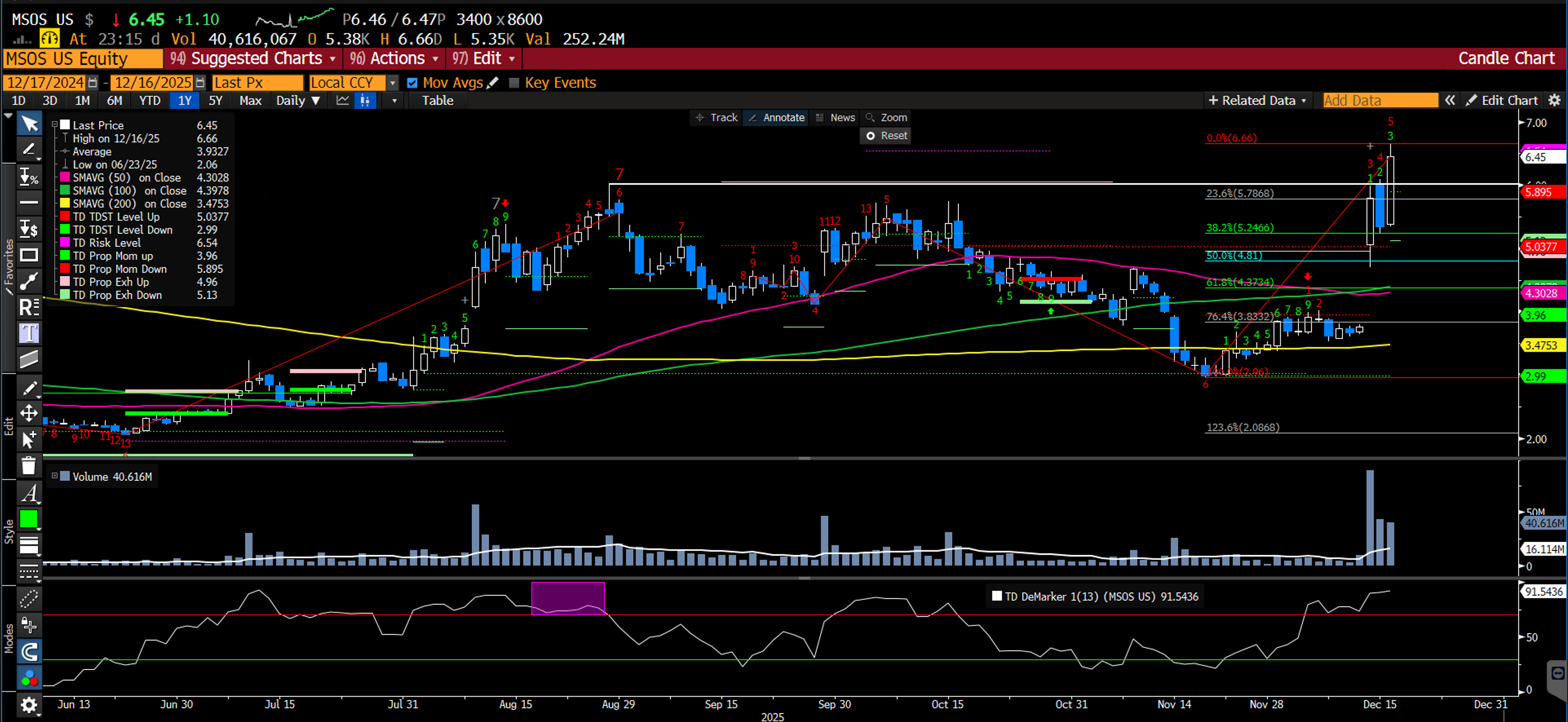
Regulatory barrier keeping cannabis “in the corner”
Indexed cannabis stocks — known as weed stocks — have long remained in the shadow of major tech and consumer sectors, despite rapidly growing U.S. markets and rising consumer demand. The main reason: the federal classification of marijuana as a Schedule I drug in the United States — the strictest category under the Controlled Substances Act — placing it alongside substances like heroin and LSD.
This regulatory framework not only blocks federal recognition of medical use but also severely limits access to banking, institutional capital, and tax benefits.
Current regime blocks capital flow
Currently:
- Canadian and U.S. cannabis companies cannot claim standard tax deductions for business expenses due to the federal code (e.g., Section 280E), putting them at a disadvantage compared to other industries;
- Banks and institutional investors generally refuse to serve companies associated with Schedule I substances, leading to expensive private loans and limited access to capital;
- Companies are forced to operate mainly at the state level, without full federal recognition, complicating interstate trade and supply chain growth.
What changed in December 2025
By mid-December 2025, serious signals emerged that President Donald Trump and his administration were considering changing the federal classification of marijuana — from Schedule I to Schedule III.
This would mean:
✔️ lower regulatory barriers for businesses;
✔️ reduced taxes and easing of codes like 280E;
✔️ easier access to banking and institutional financing;
✔️ improved prospects for medical and scientific research.
This would not federally legalize cannabis for recreational use nor fully remove current substance control rules — but it would be the most significant federal regulatory shift in the industry in decades.
Market reactions
The news triggered strong movements in weed stock prices:
- Shares of Canadian/U.S. producers like Canopy Growth, Tilray Brands, SNDL, and others rose, reaching levels seen at the highs of 2025;
- Such events often create ongoing volatility as rumors meet reality, sometimes causing pullbacks when the administration reminds that no final decision has been made.
This market response shows that investors are already pricing in the hope of regulatory relief, potentially opening the industry to broader institutional participation.
What Schedule III would change
Structural effects of moving marijuana from Schedule I to Schedule III:
Tax and financial effects
- Companies could deduct operating expenses, lowering effective tax burden;
- Banks and institutional investors may begin serving the industry, including lending, deposits, and IPO listings;
- Lower barriers for international strategic investors.
Research and innovation
- Eased requirements for scientific research could accelerate the development of medical applications for cannabis and cannabinoids.
Market legitimacy
- Moves the industry toward a more normal investment profile, potentially including NYSE/NASDAQ listings (historically a barrier).
Regulatory and political risks
- Plans are not yet final, and DEA approval is required;
- Legalization remains under Congress, which has historically blocked radical reforms;
- Political and social opposition could slow or modify the process.
Investment opportunities
If the change happens:
Potential beneficiaries
- Cannabis producers and distributors
- Financial intermediaries exposed to new fiscal opportunities
- ETFs and thematic funds focused on growing consumer sectors
Risk factors
- Increased volatility with each regulatory step
- Some companies may not realize full financial benefits if DEA approval is delayed
The potential U.S. reclassification of cannabis from Schedule I to Schedule III is not merely a bureaucratic act. It represents a structural transformation for an industry constrained by federal law, despite state legalization and a multi-billion-dollar consumer market.
For investors, it could mean easier access to capital, lower taxes, and institutional participation, potentially turning the cannabis sector from a niche asset into a mainstream portfolio component over the coming years — with all the risks and opportunities that such a transition entails.
Where should investors look: just the U.S. or the entire sector?
A key question with such a regulatory change is geographic focus. Intuitively, it seems logical to focus on U.S. companies since the classification change directly affects the United States. Market reality, however, is more nuanced.
Historically and currently, the market shows that regulatory signals have a sector-wide, not just local, effect.
- American companies – direct beneficiaries
U.S.-based cannabis operators are the first and most direct winners from a potential move to Schedule III.
- Most affected by the tax regime (Section 280E)
- Banking and financing restrictions apply mainly to them
- Federal change would unlock:
- lower effective tax rate;
- access to conventional corporate financing;
- IPO and broader institutional participation
Fundamentally, U.S. companies have the largest upside, as the change impacts real cash flows, not just sentiment.
- Canadian and international companies – indirect but market-sensitive
Market reactions show: capital first buys the rumor, then differentiates.
Canadian and international companies (Canopy Growth, Tilray Brands, Aurora, SNDL, etc.) often react in sync with U.S. counterparts, even if the regulatory change doesn’t directly affect them.
Reasons:
- Many have or plan U.S. exposure;
- Sector ETFs and thematic funds buy a basket of stocks without precise geographic selection;
- In a risk-on environment, investors seek liquidity, and Canadian stocks are often easier to trade on major exchanges.
Short-term, this creates a broad sector rally regardless of jurisdiction.
Ultimately, fundamental winners are mainly U.S. companies, while international players benefit from market sentiment rather than the regulatory change itself.
ETF or individual stocks?
Similar to oil companies during rising commodity prices, weed stocks are already splitting into “survivors” and “leveraged” players. The regulatory change acts as a price catalyst — not all will benefit equally.
ETF approach – exposure to the theme
- Suitable for investors wanting participation with lower specific risk.
Examples: - ETFMG Alternative Harvest ETF (MJ)
- AdvisorShares Pure US Cannabis ETF (MSOS)
Advantage: diversification, lower bankruptcy risk.
Disadvantage: lower upside if clear winners emerge.
Individual stocks – selective approach
- Companies with resilient business models despite regulatory limits
(“survive and profit even now”)
Examples:
- Green Thumb Industries (GTBIF)
- Trulieve Cannabis (TCNNF)
- Curaleaf Holdings (CURLF)
Features: - Positive operational cash flow
- Disciplined expenses
- Stable state-level positions
Investment logic: like major oil companies — already profitable, with additional upside if regulation eases.
- Companies with “leverage” from regulatory change
(“losing now, but high potential with relief”)
Examples:
- Canopy Growth (CGC)
- Tilray Brands (TLRY)
- Aurora Cannabis (ACB)
Most affected by: - Tax regime
- Limited capital access
Investment logic: similar to high-risk mining companies — a small regulatory shift could turn them profitable, generating disproportionate price movement.
As with oil, the strongest moves often come from companies moving from “on the edge” to “profitable.” That’s where the market seeks asymmetric upside.
 Head of Trading Dimitar Kalapov
Varchev Absolute Trader
борсова платформа
- Търгувай над 3000 финансови инструмента: Crypto, Форекс, Акции, Индекси, Суровини, ETF-и
- Използвай платформа с директно изпращане ордерите на борсите
- Cloud base платформа - твоят трейдинг сетъп на всяко устройство
- Market Sentiment - търгувай с настроенията на инвестиционите банки
- Top movers - най-горещите трейдове във всеки един момент
- Stocks scanner - филтрирай най-подходящите за твоя трейдинг стил пазарни инструменти
- Heat map - Търгувай в посоката на големите играчи
Meta Trader 5
- Търгувай Crypto, Форекс, Акции, Индекси, Суровини - всичко на едно място
- Автоматизирана търговия с интелигентни стратегии и роботи (Expert Advisors)
- Разширен технически анализ с хиляди индикатора и инструменти
- Сигурност и стабилност – платформа, доверена от милиони по света
- Нулев марджин при насрещни/хеджирани позиции
- Без комисиона при търговия със CFDs
- Светкавично изпълнение на сделките
Read more:

Login to comment
Comments:
Leave a comment