


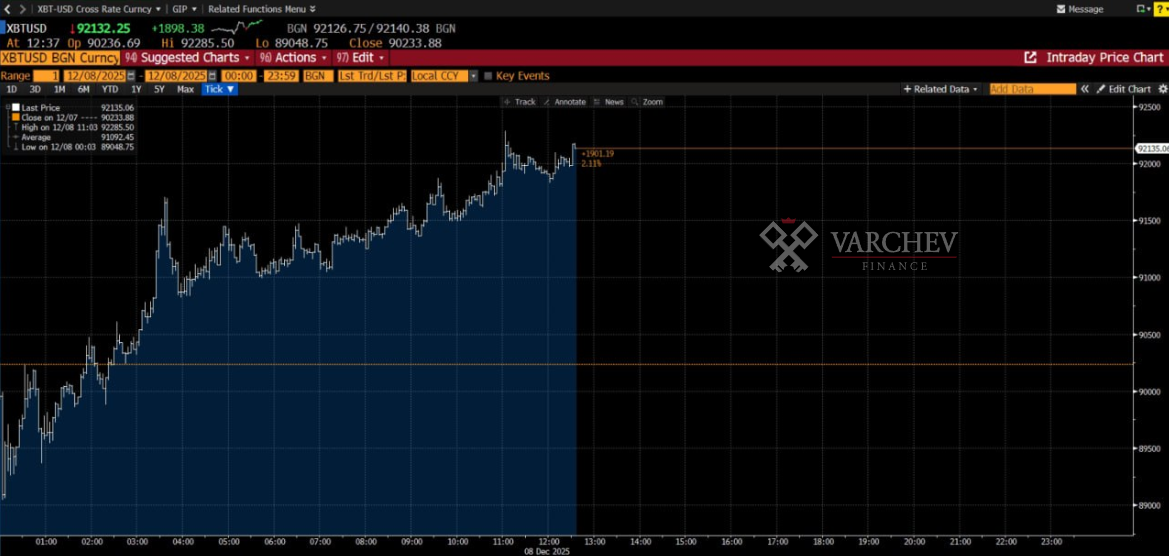
This week, Vanguard – an $11 trillion institution that long argued Bitcoin is unsuitable for long-term portfolios – adds Bitcoin ETFs for trading. Bank of America now recommends a 1–4% allocation to Bitcoin. Larry Fink of BlackRock, who once called cryptocurrencies a “money-laundering index,” now acknowledges that “his thinking has changed” while managing the world’s largest Bitcoin ETF with $70 billion in assets.
The shift extends beyond traditional finance. The Trump administration actively supports Bitcoin. Even hedge funds investing in altcoins now benchmark against Bitcoin – an implicit acknowledgment of its dominance. Altcoin projects themselves have largely stopped claiming that “X will replace BTC.”
The only persistent critics remain some media outlets, whose outdated arguments increasingly sound unconvincing.
This capitulation was inevitable. Bitcoin’s growth comes from “bottom-up” demand, which no institution can manufacture or suppress. The more people discover the value of sound money, the more the question shifts from “will they accept Bitcoin?” to “when will they admit they were wrong?”
The answer, increasingly, is: now.
Bank of America allows its advisors to recommend up to 4% Bitcoin
Starting in January, Bank of America will let its wealth management advisors recommend up to 4% allocation in Bitcoin. Initially, four spot Bitcoin ETFs are in focus, including BlackRock’s IBIT and Fidelity’s FBTC. This decision comes hours after Vanguard changed its stance, aligning Bank of America with BlackRock and Morgan Stanley, and increasing pressure on other institutions like Wells Fargo and Goldman Sachs.
The breakthrough
When the second-largest bank in the U.S. tells its advisors that Bitcoin deserves a place in client portfolios, it signals a fundamental shift in institutional thinking. Over the long term, the 4% recommendation will likely be viewed not as a ceiling but as a minimum starting point – a level that will grow as Bitcoin continues to prove its role as a preferred store of value.
Vanguard opens its platform to Bitcoin ETFs
Vanguard, the world’s second-largest asset manager, will allow its 50 million clients to trade Bitcoin and other digital asset ETFs starting December 1. Until recently, the firm claimed Bitcoin was too volatile for long-term portfolios but now acknowledges that “Bitcoin ETFs have endured periods of volatility and performed as expected while maintaining liquidity.”
The latest dominoes
When such a conservative giant with $11 trillion in assets changes its position, it becomes clear that institutions calling Bitcoin “too risky” were defending outdated business models. The pivot, led by former BlackRock director Salim Ramji, confirms that Bitcoin’s inevitability gradually overcomes even the most stubborn resistance.
Tether buys more gold than any central bank in Q3
Tether purchased 26 tons of gold in Q3 2025, surpassing the total purchases of all reporting central banks for the same period. Its total gold reserves reach 116 tons – more than Greece, Qatar, or Australia. CEO Paolo Ardoino confirmed that purchases were funded from corporate profits.
Smart companies buy hard assets
Tether’s gold accumulation highlights the principle that managing monetary infrastructure requires protection with scarce, apolitical assets. While nations often ignore this principle, Tether invests its profits in Bitcoin and gold – a strategic move for one of the most profitable firms in history per employee.
Bitcoin Policy Institute calls for Samourai pardon
Bitcoin organizations urge President Trump to pardon Samourai Wallet developers Kione Rodriguez and William Hill, convicted for unregistered money transmission activity. The institute argues that the charges misapply the law to non-custodial software. The petition has already gained support from over 3,200 people.
Code is expression, not a crime
The case risks criminalizing open-source software and discouraging privacy tool development. If non-custodial software is treated as money transmitters, innovation will likely move to more favorable jurisdictions.
BlackRock: Sovereign funds buy Bitcoin during dips
Larry Fink reveals that several sovereign wealth funds purchased Bitcoin during the recent correction – including at prices around $80,000, after the market dropped from peaks near $120,000. The funds take long-term positions, seeing Bitcoin as protection against government debt and inflation.
Smart money accumulates during volatility
Sovereign funds buy when prices are under pressure – a logical move for the world’s most experienced institutional investors.
Bitcoin adoption continues
– Xapo Bank opens its Byzantine BTC Credit Fund to a broader audience after $100 million in initial allocations.
– CFTC approves leveraged spot Bitcoin trading on regulated U.S. exchanges.
– Bitkey hardware wallets are now delivered to 9,000 points at Walgreens, FedEx, Dollar General, Albertsons, and Kroger.
– VTB, Russia’s second-largest bank, plans to offer direct Bitcoin trading to clients in 2026.
– Twenty One Capital, led by Jack Mallers, begins trading on the NYSE under the ticker XXI with 43,514 BTC.
– JPMorgan launches a structured note linked to BlackRock’s IBIT ETF, offering enhanced returns based on the halving cycle through 2028.
How Bitcoin works
This week: Bitcoin within the framework of global public goods.
Analyst Michael McNier examines the “Miran Doctrine” – a shift in how the U.S. perceives the dollar and government bond system. Instead of presenting them as neutral global infrastructure, the Trump administration now describes them as “global public goods” that other nations must pay for.
Miran proposes mechanisms to tax countries with large reserves in U.S. bonds, including “usage fees” and Federal Reserve tools to make dollar savings more expensive. This marks a sharp departure from previous policy – the dollar becomes a tool of foreign policy.
This environment makes Bitcoin more attractive to foreign reserve managers. It has no governing authority, cannot be used for political pressure, and cannot levy fees on holders.
Coin Check
When did spot Bitcoin ETFs start trading in the U.S.?
A. 2021
B. 2013
C. 2023
D. 2024
Answer: D. 2024
Since their launch in January 2024, U.S. spot Bitcoin ETFs now hold 1,310,746 BTC, or 6.242% of the maximum 21 million supply. Their value exceeds $121 billion, with BlackRock’s IBIT achieving the fastest ETF growth rate in history.
Varchev Absolute Trader
борсова платформа
- Търгувай над 3000 финансови инструмента: Crypto, Форекс, Акции, Индекси, Суровини, ETF-и
- Използвай платформа с директно изпращане ордерите на борсите
- Cloud base платформа - твоят трейдинг сетъп на всяко устройство
- Market Sentiment - търгувай с настроенията на инвестиционите банки
- Top movers - най-горещите трейдове във всеки един момент
- Stocks scanner - филтрирай най-подходящите за твоя трейдинг стил пазарни инструменти
- Heat map - Търгувай в посоката на големите играчи
Meta Trader 5
- Търгувай Crypto, Форекс, Акции, Индекси, Суровини - всичко на едно място
- Автоматизирана търговия с интелигентни стратегии и роботи (Expert Advisors)
- Разширен технически анализ с хиляди индикатора и инструменти
- Сигурност и стабилност – платформа, доверена от милиони по света
- Нулев марджин при насрещни/хеджирани позиции
- Без комисиона при търговия със CFDs
- Светкавично изпълнение на сделките
Read more:

Login to comment
Comments:
Leave a comment