


The U.S. Federal Reserve, through its ultra-loose monetary policy, is inflating a series of major bubbles – the artificial intelligence bubble, Housing Bubble 2.0, and the bond bubble. The risk of these bubbles starting to burst in 2026 is rising noticeably. Such a development could push the American economy into an inflationary depression, which might later be called the “Great Depression.” Inflation is expected to surpass the peak levels of the 1970s, while the GDP decline could approach that of the 1929–1946 period.
Despite similarities with the 2008 crisis, the impact on the economy and the dollar this time is expected to be different. The U.S. currency is likely to weaken significantly – both against gold and most global currencies.
These bubbles have been forming for years, some for more than a decade. New market leaders, such as major tech companies, are gaining enormous capitalization, the housing market is reaching historically high levels, and the stock market continues to rise without significant corrections. This lulls investors into complacency and makes them underestimate risk. Roosevelt’s words, that “the only thing we have to fear is fear itself,” seem more relevant to the American investor today than in the 1930s.
Nevertheless, all major indicators point to inflated valuations across several sectors, and the dollar appears vulnerable. This means that dollar-denominated investments – in stocks, bonds, and real estate – could face challenging years ahead. The U.S. economy is heading toward a recession that could make the 2008 crisis look mild.
I. The Dual Role of the Federal Reserve – Both Arsonist and Firefighter
The Federal Reserve continues to act as a driver of monetary inflation – a necessary condition for bubble formation. The classic analogy is that the central bank first sets a fire through prolonged low interest rates and then attempts to extinguish it with new stimulus measures. This cycle has been repeating for over 35 years.
In the 1990s, low interest rates led to the tech bubble. After the Nasdaq crash in 2000, the Fed quickly lowered rates to 1%, which fueled the first housing bubble. Following the collapse of Lehman Brothers in 2008, rates fell to zero and remained there for nearly 15 years – an unprecedented event in millennia of monetary history.
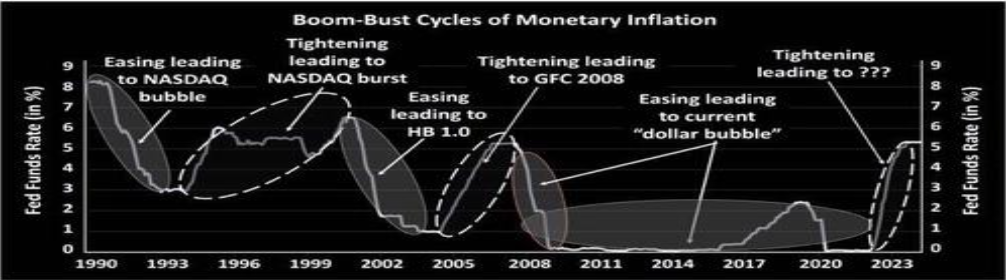
But interest rates are only part of the picture. Through quantitative easing, the Federal Reserve has increased its balance sheet more than sixfold – from under $1 trillion in 2008 to over $6.5 trillion today. The national debt has also soared – from $10 trillion before 2008 to nearly $40 trillion now. With the continuation of current fiscal policies, the U.S. could surpass the $50 trillion mark by 2028.
This combination of record debt and easy money is creating massive bubbles that will eventually encounter their “pin.” The system is in a fragile equilibrium.
II. When Bubbles Clash with Economic Reality
The surplus of money and credit is directed toward specific sectors, leading to new bubbles – housing, technology, and bonds.
II.1 Housing Bubble 2.0
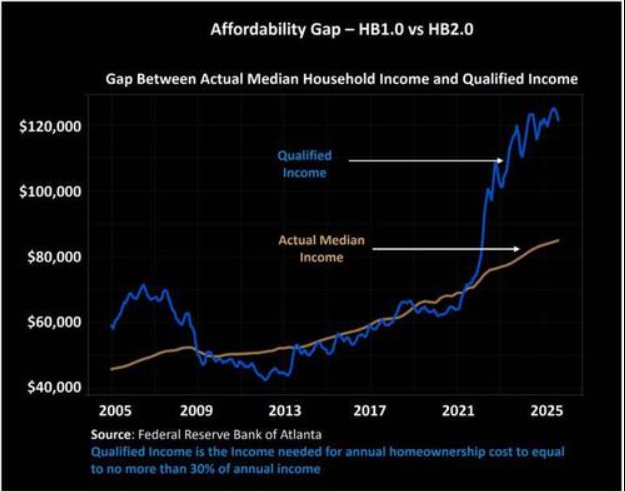
The Housing Affordability Index shows that prices would need to drop by more than 33% to become realistic relative to incomes again. When Bubble 2.0 bursts, a decline of up to 50% in some areas would not be surprising. This time, however, the Federal Reserve will not be able to simply return to zero interest rates and print trillions as it did after 2008, because other bubbles are also inflating.
II.2 The Artificial Intelligence Bubble
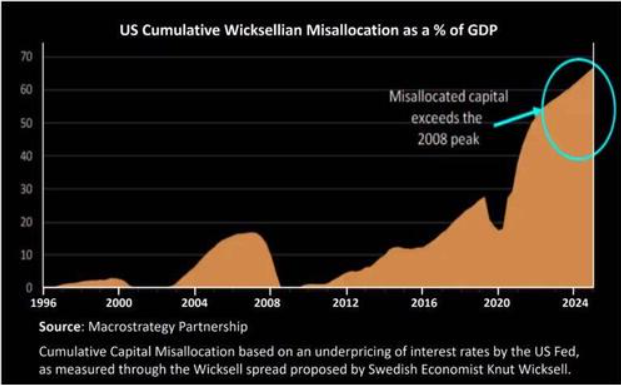
Investments in technology, cryptocurrencies, NFTs, data centers, and new AI services have reached levels that far exceed those of the dot-com era. Much of the capital is now seeking merely to “get back what was invested,” rather than profit. Market concentration is high, and the valuations of leading companies are growing faster than the real economy.
II.3 The Bond Bubble
Investors are paying a high price today for 30-year government bonds, which may ultimately have little real value if the dollar continues to lose purchasing power. At present, U.S. finances resemble a company with massive losses, enormous debt, and automatically triggered obligations totaling hundreds of trillions.
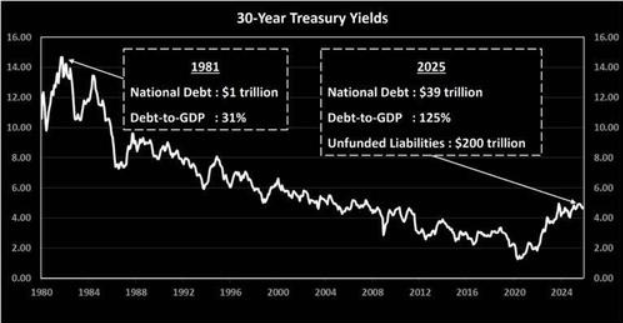
Risks to the national debt are rising, while rating agencies largely overlook the fundamentals. If interest rates increase in the coming years amid a recession, the bond market could experience its most severe cycle in modern history.
Forecast for 2026
It increasingly appears likely that Housing Bubble 2.0 and the AI bubble will burst one after the other. For the first time in decades, the U.S. administration and the Federal Reserve will realize that printing money will deepen the crisis rather than resolve it. Unlike in 2008, when the problem was liquidity, the situation in 2026 could become a solvency issue.
The dollar risks weakening significantly – not only against precious metals but also against the currencies of major trading partners. The economic decline could be prolonged, with its depth reflecting the scale of the previous inflationary surge.
Since 2008, monetary expansion has been unprecedented – both in volume and in nature. This increases the risks of a severe depression. Gold already reflects this – rising from $250 in 2000 to over $4,200 today, indicating a dramatic erosion of purchasing power.
Any attempt at new stimulus now would be like pouring gasoline on a fire. And yet, it is likely that Washington will pursue precisely this approach.
Global Context
Many countries face similar problems – high deficits, growing debts, and dependence on easy money. The U.S. is at the center of the process due to the dollar’s status as the global reserve currency, but to a lesser extent, the pressure will be felt worldwide.
The solution for individual countries is the same – stable budgets, real market mechanisms, fewer regulations, and more economic freedom.
Varchev Absolute Trader
борсова платформа
- Търгувай над 3000 финансови инструмента: Crypto, Форекс, Акции, Индекси, Суровини, ETF-и
- Използвай платформа с директно изпращане ордерите на борсите
- Cloud base платформа - твоят трейдинг сетъп на всяко устройство
- Market Sentiment - търгувай с настроенията на инвестиционите банки
- Top movers - най-горещите трейдове във всеки един момент
- Stocks scanner - филтрирай най-подходящите за твоя трейдинг стил пазарни инструменти
- Heat map - Търгувай в посоката на големите играчи
Meta Trader 5
- Търгувай Crypto, Форекс, Акции, Индекси, Суровини - всичко на едно място
- Автоматизирана търговия с интелигентни стратегии и роботи (Expert Advisors)
- Разширен технически анализ с хиляди индикатора и инструменти
- Сигурност и стабилност – платформа, доверена от милиони по света
- Нулев марджин при насрещни/хеджирани позиции
- Без комисиона при търговия със CFDs
- Светкавично изпълнение на сделките
Read more:

Login to comment
Comments:
Leave a comment