


A few days before Donald Trump returned to the White House, George Santos walked up the steps of the nearby Andrew W. Mellon Auditorium. It was January 17, the start of inauguration weekend, and the disgraced former U.S. congressman was heading to a crypto ball with $2,500 tickets.
Santos passed rows of men in tuxedos and entered the neoclassical building. Inside, House Speaker Mike Johnson posed for photos with influential figures and crypto lobbyists, while Donald Trump Jr. filmed a TikTok clip. Also present were Brock Pierce, former “Mighty Ducks” actor and now co-founder of a crypto company valued at $180 billion, and Trump political advisor Aline Haba, who played with a claw machine. Future Treasury Secretary Scott Bessent appeared, as did Zak Folkman, a former dating coach and now one of the Trump family’s business partners in the crypto industry.
Before Snoop Dogg took the stage as DJ, some guests pulled out their phones to see a post from the future president on his social network, Truth Social. He created his own cryptocurrency called Trump. “Have fun!” he wrote, and the price started to rise. Some guests were frustrated they hadn’t gotten in earlier, while others suspected the account had been hacked.
It turned out the currency was real—not with actual investment value, but not a hack either. It was a so-called “meme coin,” a digital token based on hype. That same weekend, his wife Melania launched her own token, Melania. It was as if the Trump family had filled the National Mall with slot machines branded with their names.
The coin prices soared so high that, for a few hours, Trump and his business partners were sitting on at least $50 billion in assets. Then the value dropped. Hundreds of thousands of ordinary people lost money. According to estimates by crypto analytics firms Chainalysis and Bubblemaps, Trump’s team likely cashed out more than $350 million.
Almost no one besides the few big winners was satisfied. Critics accused the scheme of corruption, claiming the Trump coin allowed foreign investors to make unlimited anonymous payments to the future president. Crypto traders complained of being defrauded. The new administration assured the public that everything was legal. “Neither the president nor his family participated or will participate in conflicts of interest,” said White House spokesperson Caroline Leavitt.
The entire operation took place almost openly, but no one knows exactly how Trump and his wife created their coins. Presumably, someone explained to them what meme coins are and how profitable they could be. The question remains: who are their mysterious partners—the ones who know how Trump extracts so much money from his fans.
The story traces back to the very origins of meme coins—an unregulated, almost meaningless form of gambling that has taken the crypto world by storm. It began with a young entrepreneur who made billions, an “Argentine phantom” who sparked a national scandal, and a Singaporean crypto creator with an online cat avatar in a space helmet.
Together, they set a new standard for turning hype into money and laid the groundwork for a year of unprecedented presidential profit. Although meme coins gradually fade, the example shows what can happen when the rules are written by the “hype men” themselves.
It all started as a joke. In 2013, two software engineers used a photo of a fluffy Shiba Inu dog with a scowling expression, popular on online forums like Reddit and 4chan, for their new cryptocurrency, Dogecoin. The token was intended to be as absurd as possible, parodying the multitude of digital currencies that followed Bitcoin. But investors joined in, and within weeks, the market value reached $12 million.
Their success defied all basic financial principles. Even the biggest stock market bubbles are based on hope for a company’s or industry’s potential. Meme coins, however, create no product or revenue—they have no intrinsic value. Profit comes only if others buy the same useless tokens. The speculation is built on speculation itself.
“According to efficient market theory, this shouldn’t work, but in practice—it does,” says Alon Cohen, co-founder of Pump.fun, the most popular app for creating and trading meme coins. His app has been used to launch about 14 million meme coins, though not Trump’s. Pump.fun estimates that trading fees have reached around $1 billion since January 2024.
Cohen, 22, with short black hair and a stubbled beard, demonstrated in a Manhattan café how the meme coin market works through his app. The interface is simple and retro, with pixelated icons, each advertising a different coin. Creating a new token takes just a few clicks—no coding, no paperwork, no knowledge of the Solana blockchain where it will be traded.
Almost anything that becomes popular online or makes the news can be turned into a meme coin. Even tragic events, like the alleged killing of Charlie Kirk, inspired thousands of tokens. Coin creators compete for attention through provocative live stunts—from sexual performances and fentanyl use to beheading a chicken (sometimes it’s hard to tell what’s real). Some coins in Cohen’s app have racially charged names, but the site offers an option to hide offensive content, and the moderation team removes anything illegal.
Buying a meme coin via the app is just as easy. Prices start at a fraction of a cent and rise with demand according to a formula. Pump.fun’s main users are young, predominantly male, active online—types who discuss trades on X and Discord. Coins that gain attention are listed on major platforms like Binance and Coinbase, attracting more investors and driving prices up. Picking a winning token can multiply profits tenfold or more within hours.
Cohen says the app was created to give everyone a fair chance to join the next “big hit.” “It’s like a game, but we want it to be fair,” he says.
Other traders and meme coin creators, however, see things differently. They describe a complex world of schemes and scams, hard for outsiders to understand. At its core is an obvious conflict of interest—creators promise to sell a limited number of tokens at a low price, but once the price rises, they are incentivized to sell as many as possible. “Show” trades are often used to create the illusion of activity, or influencers are paid for apparent organic hype. Regardless of what happens, the only consistent winners are those who get in first.
No participant seems particularly concerned about the legality of meme coins. A month after Trump’s inauguration, the U.S. Securities and Exchange Commission (SEC) announced it would not regulate them. The agency clarified that other fraud laws could still apply—fraud is fraud, whatever the medium—but so far, other regulators and prosecutors have not intervened.
The shadowy nature of the meme coin market is no secret. Almost all investors, except the most naive, know how things stand, yet still hope to profit before the coin inevitably collapses. It’s like a “coordinated scam.”
The name of a famous person on a meme coin often draws significant attention. Most celebrities avoid such projects to protect their fans. Before Trump, the most notable examples were Caitlyn Jenner, Australian rapper Iggy Azalea, and Haley Welch from viral videos.
Trump proved to be almost the perfect “market spokesperson” for the meme coin industry. During his presidential campaign, multiple coins with “Trump-inspired” names were created to win the family’s approval. It was clear that Trump’s endorsement immediately turned a coin into a market leader. When this happened, no one officially claimed credit, except a subtle hint in the company name at the bottom of the site: Fight Fight Fight LLC.
Before the Trump meme coin began trading, Mar-a-Lago Club in Florida buzzed with crypto profit opportunities. The family was already promoting one project—World Liberty Financial Inc.—raising $550 million through the sale of their own coins, while Trump promised to deregulate the crypto industry, which had been under pressure during the Biden administration. Companies donated millions to Trump’s inauguration and lobbied to benefit under his leadership.
A crypto creator who visited Mar-a-Lago at the time told Businessweek that plans for Trump’s meme coin were developed only a few weeks before its debut. The team rushed to launch the coin before inauguration day.
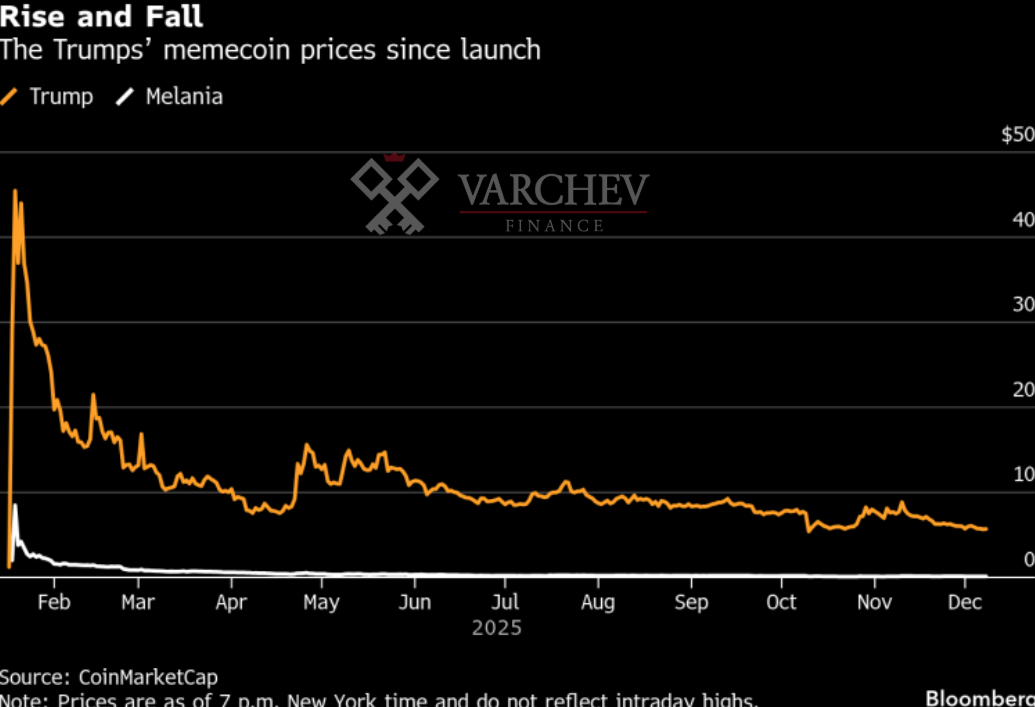
When the meme coins hit the market, it was the busiest weekend for meme coin trading. The price of the Trump coin shot up from nearly zero to $74. When Melania introduced her token two days later, it reached $13. The next day, however, both coins began to fall and have yet to recover.

On his first full day in the White House, Donald Trump was asked at a press conference about his meme coin. He claimed to know little about it, other than that he had launched it. “I heard it’s very successful,” he said, then asked how much money he had made.
The meme coin’s website lists no executives and gives the address of a UPS office across from a tire shop in West Palm Beach, Florida. However, one of the few available corporate documents from Delaware mentions an “authorized person”—Bill Zanker.
The name is familiar—Zanker, a 71-year-old entrepreneur, co-authored Trump’s 2007 book Think Big and Kick Ass in Business and Life. Over the years, he promoted psychic lines, boxing gyms, and a chain of massage studios, and is best known for Learning Annex seminars, including courses like “Your Own Greeting Card Business” and “How to Cheat on Your Spouse.” In the 2000s, he organized large real estate expos with Trump as the main attraction. In 2013, the two launched a crowdfunding platform with a press conference at Trump Tower, where models handed out cash from aquariums. The site failed to gain traction.
In 2022, while Trump was out of power and defending himself against allegations of financial fraud and sexual assault (which he denies), Zanker offered a new way to profit—NFTs (non-fungible tokens). They released digital “cards” for $99, featuring muscular Trump in various heroic poses and effects. Trump’s licensing fees amounted to at least $7 million. During the 2024 reelection campaign, they sold “Never Surrender” watches, perfumes, and sneakers.
For Zanker, meme coins were not an unusual idea, but he himself is difficult to reach. Attempts to contact him via phone, messages, and email were unsuccessful. His son Dylan participates in crypto conferences but declined to comment on the meme coins.
The next clue comes from Trump’s meme coin website: in April, a message appeared stating that the largest holders would have a gala dinner with the president at Trump National Golf Club in Virginia. The 220 largest buyers were invited. Senator Elizabeth Warren called the dinner “an orgy of corruption.” Many of the largest buyers were crypto businessmen interested in influence over the administration. The largest holder was Justin Sun, a Chinese crypto billionaire who purchased about $15 million. He has a pending fraud case, raising suspicions of a “service-for-service” deal.
At the dinner itself, protesters gathered in the rain. Sun arrived with an assistant holding an umbrella and three operators. Security checks required identification, including foreign passports, while protesters mocked the guests. The menu was filet mignon, hosted by Zanker in a blue suit and red tie. Trump arrived by helicopter, gave his usual “crypto speech,” and left. The event confirmed Zanker’s involvement but did not reveal how the president created and traded his coin.
After Trump, another world leader joined a meme coin venture—Javier Milei, president of Argentina. On February 14, he endorsed a coin called Libra. Its price fell within hours, and Milei deleted the social media post.
Crypto trades are recorded on a public ledger (blockchain), allowing transactions to be traced. Crypto detective Nicholas Wyman identified anomalies: one person bought Trump’s meme coin for $1.1 million within seconds and sold it three days later for a $100 million profit. Another address bought Melania before its announcement and earned $2.4 million. According to Wyman, these actions resemble insider trading, but no regulatory agency has applied such rules to meme coins. In his words: “In crypto, crime is legal.”
Wyman found a connection between wallets, showing that Milei’s coin creator was linked to Melania’s. Milei’s advisor, Hayden Davis, a former Liberty University student, described himself as an “expert in clever deals.” He and his father created Kelsier Ventures—a company acting as an investment bank for meme coins, connecting investors with influencers and managing trades. Coins they helped launch followed a pattern of rising and crashing after insider sales. Wyman estimates Davis and partners’ profits exceeded $150 million, over half from Libra.
The scandal erupted when Davis admitted to a YouTube investigator that the meme coin industry he promoted was “unfair” and “an unregulated casino system.” He described the practice of “sniping”—buying new coins with inside information and selling as others joined to profit at their expense.
Hayden Davis acknowledged helping create Melania Trump’s meme coin but did not specify his exact role and claimed he did not profit from it. “I was part of it,” he said, sounding almost ashamed. He advised ordinary investors to stay away, as they would likely be “robbed.” “Trump, Melania, Libra—you can go on forever. It’s all a game.”
Businessweek reviewed screenshots of messages Davis sent to an associate immediately after Trump’s meme coin launch, before Melania’s coin was announced. In the messages, he promised to tip off friends and mentioned Milei’s planned coin, which was also secret at the time. Davis boasted of making “crazy sums” from meme coin launches and hinted he might be involved in Trump’s coin. “Trump’s coin gives me more power than ever,” he wrote. “Which also carries huge risk.”
However, Davis declined to speak to Businessweek. “All stories published are quite crazy and untrue,” he said via text. His lawyer cited “mass inaccuracies” in the queries but did not specify which.
A former Davis associate, Moti Povolotsky, emerged as a sort of “witness.” He co-founded crypto startup DefiTuna and claims evidence of a larger scheme. According to him, top managers of a crypto exchange were involved. His account is complex, but he is the only one willing to tell what happened behind the scenes.
Povolotsky says Davis hired his firm to assist with meme coin trading. This alone is not suspicious, but Davis focused primarily on personal profit. When Povolotsky’s business partner asked how to manage trading for an upcoming meme coin, Davis advised selling as many coins as possible, even if the price dropped almost to zero: “We’re trying to squeeze every last bit from this one.”
The same happened with Melania’s coin—about 10 million tokens were transferred to Povolotsky’s partner with instructions to sell once they reached $100 million. Sales were to remain anonymous.
Two weeks later, Povolotsky visited Davis in Barcelona during the launch of another meme coin, “Enron.” There, Davis’s father demonstrated an automated “sniping” program for coins. Povolotsky severed ties with Davis and his partner after these observations.
Another key player is “Meow,” co-founder of the Meteora exchange, which Davis connected with. Meteora is larger and more customizable than Pump.fun and was used for the debut of Trump, Melania, and Libra coins. Meow is an anonymous figure among traders, also known for his own trading app, Jupiter. He claims to provide only “technical support” and does not engage in trading manipulation.
Meow (real name Ming Yeu Ng) was born in Singapore and has a background in computer engineering. In the early 2010s, he created the Mr. Tweet service, then in 2021 launched Mercurial Finance, backed by Sam Bankman-Fried’s fund. After Bankman-Fried’s scandal, Ng rebranded the app as Meteora.
He claims about 90% of the exchange’s revenue ($134 million last year) comes from meme coins, which carry higher fees. Ng views the market pragmatically: coin value reflects users’ beliefs. “Everything is a meme coin—even the U.S. dollar,” he says.
Regarding Davis and Trump coins, Ng asserts his platforms are decentralized and not intended to control creators’ intentions. “We only provide the technology, we don’t participate in shady deals,” he says. Ng explains that moral judgments are not his priority and metaphorically compares the industry to a baby in dirty water: “Someone made a mess, but there could be a baby inside. I say the baby could be there.”
At Meteora, the team demonstrated a new QR code for easy coin creation and even a new meme coin, “Pony Fart Empire.” Ng claims major meme coin launches were not fundamentally important to his business and that his plans are much larger: “Money can be infinite. What if we could create money for every problem?”
Ming Yeu Ng describes crypto as a “microcosm” of the world—a reflection of people’s desires. “People want to make instant money. They don’t want to work for things,” he says, while pouring fish balls into his bowl.
In practice, someone clearly wanted quick money when the Trumps created their meme coins. But month after month, prices fall, with few minor celebrities stepping in to attract players’ attention. By November, total meme coin trading volume had fallen 92% from the January peak, according to Blockworks. Buyers continue losing money, almost wiped out.
In June, Fight Fight Fight announced plans for a new crypto trading app, but the president’s sons denied it was approved by the family, which was developing its own app. Zanker’s latest plan, announced in December, is a mobile game Trump Billionaires Club, including Trump’s meme coin. The news did not affect the price—by December 10, Trump’s coin had dropped 92% from its peak to $5.90, and Melania’s coin 99%, to 11 cents.
Davis is isolated, which is difficult in an industry that usually ignores rules. His location is unknown, and his social media is silent, although blockchain data shows his wallets still trade meme coins.
Ng and Meteora continue their projects. In October, the exchange issued its own crypto token with a market value over $300 million.
The question remains how the Trumps realized such enormous profits so quickly. In the stock market, a suspiciously large gain can prompt regulators to demand access to trade records and private messages. This does not happen with meme coins.
In New York, lawyer Max Berwick is trying to hold the meme coin market and creators accountable. He filed lawsuits against Pump.fun in 2025, calling the platform an “insider casino machine,” and against Davis, Chow, and Meteora for alleged “pump-and-dump” schemes. The lawsuits are ongoing, with no claims of wrongdoing against the Trumps or Milei. All defendants deny the allegations.
“The people behind the meme coin boom have made hundreds of millions exploiting innocent investors,” Berwick says. “The entire scheme was designed by highly skilled people for maximum profit.”
The Trump family has moved to a more diversified portfolio of interests while continuing to claim their financial interests do not influence politics. The president proposed that the U.S. government acquire a “strategic reserve” of Bitcoin; his son Eric runs a Bitcoin mining company. The family is also involved in licensing their name for a skyscraper in Jeddah, Saudi Arabia, and Trump pardoned billionaire Changpeng Zhao—Binance co-founder, supporting another Trump crypto project.
Many influencers who previously promoted meme coins are now turning to prediction markets. Under the Biden administration, these markets were blocked as illegal gambling, but the Trump administration is more open, and the family participates actively. On Polymarket and Kalshi, where Donald Trump Jr. is an advisor, users can bet on sports events, elections, and almost anything else.
- Source: Bloomberg Terminal
Varchev Absolute Trader
борсова платформа
- Търгувай над 3000 финансови инструмента: Crypto, Форекс, Акции, Индекси, Суровини, ETF-и
- Използвай платформа с директно изпращане ордерите на борсите
- Cloud base платформа - твоят трейдинг сетъп на всяко устройство
- Market Sentiment - търгувай с настроенията на инвестиционите банки
- Top movers - най-горещите трейдове във всеки един момент
- Stocks scanner - филтрирай най-подходящите за твоя трейдинг стил пазарни инструменти
- Heat map - Търгувай в посоката на големите играчи
Meta Trader 5
- Търгувай Crypto, Форекс, Акции, Индекси, Суровини - всичко на едно място
- Автоматизирана търговия с интелигентни стратегии и роботи (Expert Advisors)
- Разширен технически анализ с хиляди индикатора и инструменти
- Сигурност и стабилност – платформа, доверена от милиони по света
- Нулев марджин при насрещни/хеджирани позиции
- Без комисиона при търговия със CFDs
- Светкавично изпълнение на сделките
Read more:

Login to comment
Comments:
Leave a comment