


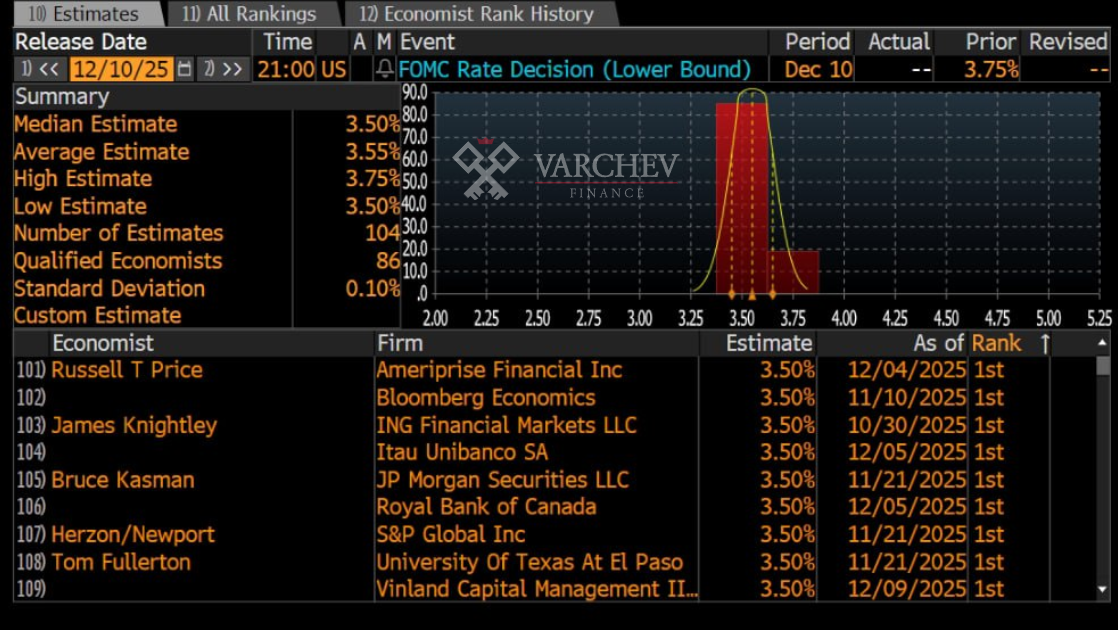
The Federal Reserve is set to cut its key interest rate by 25 basis points to a range of 3.50–3.75%, with Fed funds markets currently pricing in about a 90% probability for this scenario. Expectations are for a reduction despite deepening disagreements among policymakers, with numerous dissenting votes anticipated on Wednesday from both more “hawkish” and more “dovish” members.
If the decision is made, it will follow the October cut and bring the total rate reduction to 175 basis points since the start of the easing cycle in September 2024. At that time, Fed Chair Jerome Powell warned that a December cut was far from guaranteed, likening the situation to driving in fog, where it is prudent to slow down.
As Newsquawk notes, the temporary government shutdown has delayed the release of key economic data, leaving limited new information since the last meeting. However, next week will bring the release of October and November nonfarm payrolls, November unemployment figures, and CPI inflation data for the same month. These follow very strong JOLTS job openings data for September and October.
Although markets have largely priced in a rate cut, the upcoming vote remains contested. As a result, investors broadly expect the Fed’s next move to be a so-called “hawkish cut,” accompanied by a cautious tone on future monetary policy.
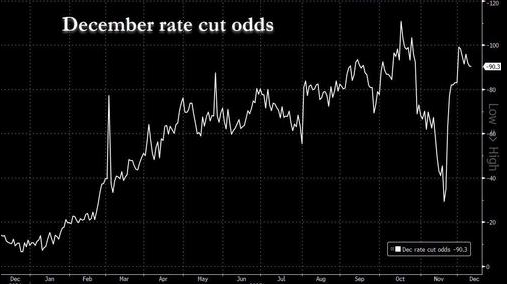
But what does a “hawkish cut” actually mean? This is a scenario in which markets expect very limited additional rate reductions—under 8 basis points in January and less than a full 25-basis-point cut in the first three Fed meetings of 2026, after which Jerome Powell’s term as chair expires. According to Bank of America, investors have generally assumed that a mid-cycle adjustment typically involves around three cuts.
JPMorgan notes that such a message could be conveyed through the wording in the official statement, if it resembles last year’s guidance. In November, the Fed then used the phrase “considering further adjustments,” followed by a December cut. Subsequently, the wording was changed to “considering the size and timing of further adjustments,” which was followed by a pause in rates until September 2025. Returning to similar language could signal a pause as early as the January meeting.
JPMorgan Chief Economist Michael Feroli expects both the statement and the post-meeting press conference to carry a stricter tone. At the same time, he believes that a potential weakening of the labor market could lead to another rate cut in January, although markets currently assign this a probability of less than 30%.
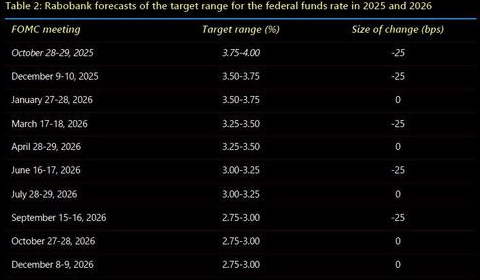
In the longer term, Rabobank expects the Federal Reserve to continue its rate-cutting cycle at least until it reaches the central bank’s estimated neutral rate.
Hawks vs. Doves: During the post-meeting press conference of the Federal Open Market Committee in October, Chair Jerome Powell noted that there is significant divergence of opinions among members regarding the next steps. He emphasized that another rate cut in December is far from certain due to inflationary risks.
Powell described the October cut as another move to manage risks but indicated that the approach going forward would be different. Referring to the lack of sufficient data at that time, he stated that this could influence the December decision and used the analogy of driving in fog, when it is wiser to reduce speed.
Despite this clearly expressed caution from the Chair, not all Committee members share the same view. Some economists and Fed officials continue to support additional rate cuts. Among them is New York Fed President John Williams, who stated that a cut in the near future could be appropriate.
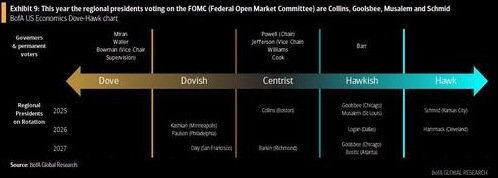
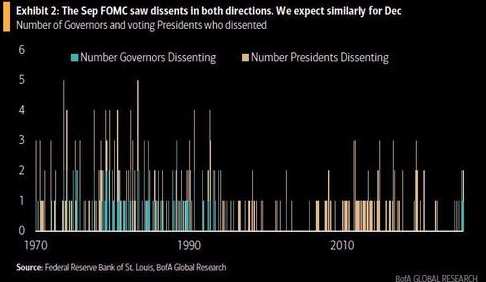
An analysis by Newsquawk shows a clear split among the voting members of the Federal Reserve. Four of them openly support a rate cut – Bowman, Waller, Mieran, and Williams. One member, Cook, is viewed as leaning toward a cut, while the positions of Chair Jerome Powell and Jefferson remain unclear.
At the same time, five members lean toward keeping rates unchanged – Barr, Schmid, Collins, Musalem, and Goolsby. This significant division sets the stage for the current meeting to potentially produce the largest number of dissenting votes since the early 1990s. Market estimates indicate about a 22% probability that four members will oppose any rate cut.
There is also a scenario in which the vote could result in three different positions – votes against the decision itself, votes in favor of the cut, and separate dissent in favor of a more aggressive 50-basis-point reduction, as proposed by Mieran.
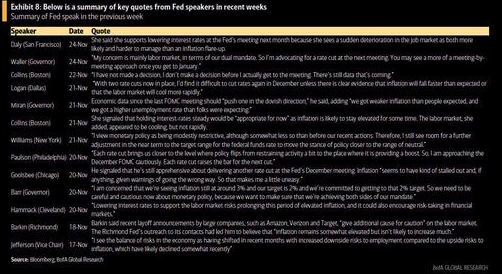
To gain a clearer understanding of the wide range of views among Federal Reserve representatives, several key statements have been made in recent weeks by both more “hawkish” and more “dovish” members. These comments highlight the deep divisions within the Committee and demonstrate just how varied the perspectives are regarding the pace and direction of future monetary policy.
DATA: Due to the prolonged government shutdown, several key U.S. economic data releases are missing, increasing uncertainty about the future path of monetary policy and contributing to deep divisions within the Fed. This is also evident from the minutes of the October meeting. As statistical reporting resumes, a clearer picture is emerging – initial jobless claims are gradually declining, with the latest report at just 191,000, the lowest level since September 2022, although there are concerns about seasonal effects around Thanksgiving. Meanwhile, the JOLTS report for October shows job openings rising to 7.67 million from 7.23 million in August and above the September level of 7.66 million. Nonfarm payroll data for October and November will be released on December 16, with no official unemployment data for October. CPI inflation for November will be released on December 18.
FED CHAIR: The 2026 outlook is further complicated by the upcoming selection of a new Federal Reserve chair by President Donald Trump, expected in early January. If the choice falls on a clearly “dovish” candidate, such as National Economic Council director Kevin Hassett, the likelihood of further rate cuts in 2026 increases.
PAUL’S PRESS CONFERENCE: According to Rabobank, Jerome Powell is likely to downplay internal disagreements, presenting them as a result of a challenging environment with upward inflation risks and downside risks to employment. Regarding January, he will emphasize that Fed decisions will remain strictly data-dependent and taken on a meeting-by-meeting basis. Any clearer signal about the next steps, however, will be key for the markets. Back in October, his statements that a December decision was not predetermined led to a noticeable “hawkish” market reaction.
Bank of America takes a more skeptical view, noting that Powell faces the most divided committee in years. He is therefore expected to balance the anticipated rate cut with a stricter tone at the press conference, as he did in October. At the same time, the bank doubts he will be able to distance himself from the interpretation of strong data dependence. Investors will remain cautious, as a large volume of statistics is expected before the January meeting – employment data for October and November, unemployment for November, retail sales for October, and CPI for November. This further complicates signals at a time when Powell is entering the final months of his term.
SIGNALLING A PAUSE IN JANUARY: One possibility is for Powell to indicate that a new rate cut would require a significantly weaker labor market. He will not commit to specific numeric thresholds but may outline qualitative guidance. Another option is to emphasize that a rate of 3.5–3.75% is not restrictive in real terms, while inflation remains above target. However, Bank of America believes he is unlikely to take such a hard stance given his more moderate approach.
THE “HAWKS” PERSPECTIVE: Up to eight regional Fed presidents, and likely one governor, may prefer to maintain current rates. Reasons vary – from doubts about whether labor demand is truly weakening, to concerns about second-round inflation effects from tariffs, to the risk of accelerating inflation with further cuts. These arguments provide the markets with guidance on the conditions under which new cuts could follow.
According to Morgan Stanley, Powell will signal that the “recalibration” phase of monetary policy is over. From now on, any change will be discussed on a meeting-by-meeting basis and fully data-driven. His tone will be cautious but flexible – current policy is well-positioned against risks, and future decisions will depend on economic developments.
Goldman Sachs expects Powell to sound very close to his October tone, emphasizing that nothing is pre-set and that the Fed is now closer to a neutral level. According to the bank, this will reflect the stricter segment of the Committee, but any indication that the Fed remains sensitive to labor market risks will be reassuring to investors.
BALANCE SHEET POLICY: Since the last meeting, attention has also turned to the Fed’s balance sheet, after the Committee decided to end its portfolio runoff on December 1. Several Fed officials have already signaled that the balance sheet is likely to start increasing again in the coming months, suggesting that a technical balance sheet expansion is possible in the relatively near term.
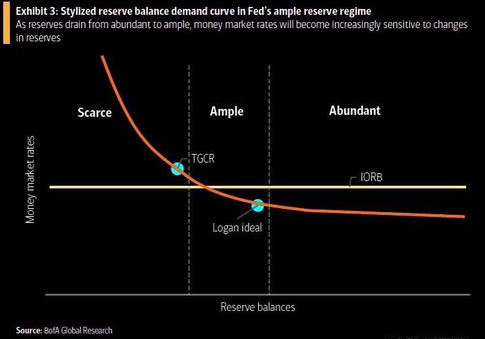
In this context, Bank of America expects the Federal Reserve to make an additional announcement related to so-called reserve management purchases alongside the rate cut. Such a move would involve monthly purchases of short-term U.S. Treasury securities totaling around $45 billion, aimed at maintaining bank reserves and preventing liquidity stress in the markets.
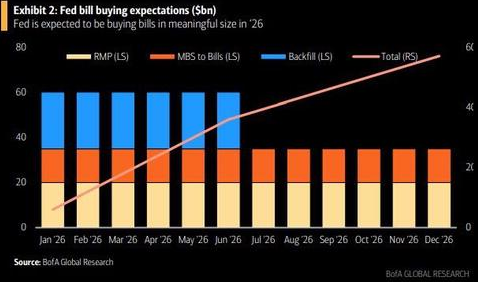
Combined with MBS reinvestments, total purchases of government securities could reach around $60 billion per month. Bank of America clarifies that these “reserve management purchases” do not constitute quantitative easing (QE) and are intended to maintain the functioning of money markets rather than stimulate lending. Although many may perceive them as “money printing” since they inject liquidity into the system, this move could calm markets amid rising government debt issuance and liquidity concerns. Additionally, it is likely to significantly boost the prices of non-fiat assets.
Updated Forecasts (SEPs): The release of updated Summary of Economic Projections is expected. A Reuters survey shows no consensus in the 2026 “dot plot,” with the median projecting two additional rate cuts, but significant disagreements remain due to fiscal risks, tariff effects, and concerns over the Fed’s independence. Conflicting signals from policymakers further increase uncertainty. Analysts highlight the wide gap between consumer and market inflation expectations, complicating the Fed’s task, with PCE inflation expected to remain above 2% through 2027.
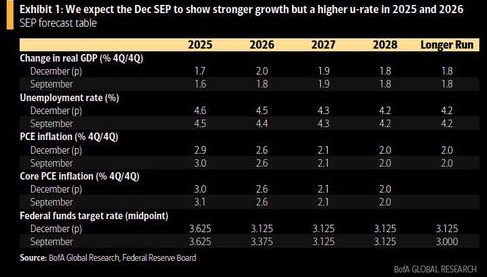
The U.S. economy likely grew by 3.0% in Q3, slowing to 0.8% in the current quarter, with Reuters surveys projecting an average growth of 2.0% for 2026. Wells Fargo expects only minor adjustments to its 2026 forecast, with slightly higher GDP and unemployment, and marginally lower inflation. The bank notes that the median “dot” for 2026 remains at 3.375%, although a lower “dot” could pull it down, with risks slightly tilted toward lower levels. JPMorgan expects, as in September, that the median participant will forecast one additional rate cut in each of the next two years. The bank does not anticipate major changes in economic forecasts and expects the official statement to reference the “magnitude and timing of further adjustments,” subtly signaling that additional rate cuts are less likely in upcoming meetings. GDP and unemployment forecasts remain unchanged, with a slight downward revision for inflation. According to Goldman Sachs, the client consensus is that the 2026 “dots” will be slightly more hawkish than currently reflected in the market. Overall, the trading community expects one projected cut next year, with many non-voting members whose forecasts are included in the “dot plot” likely to suggest 0 for 2026, balancing the more moderate committee members.
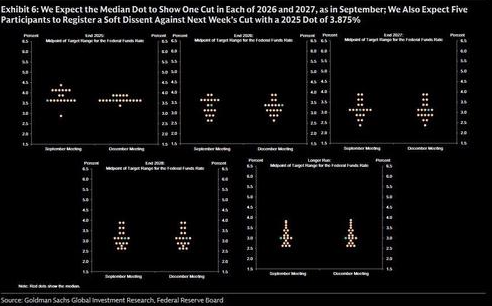
Dot Plot: Goldman expects the median projection in the dot plot to show one rate cut in 2026 to 3.375% and another in 2027 to 3.125%, as was the case in September. However, this is a narrow projection dependent on a single participant. Overall, little movement in the dots is expected compared to September, as there are no significant new economic data or events to change the outlook.
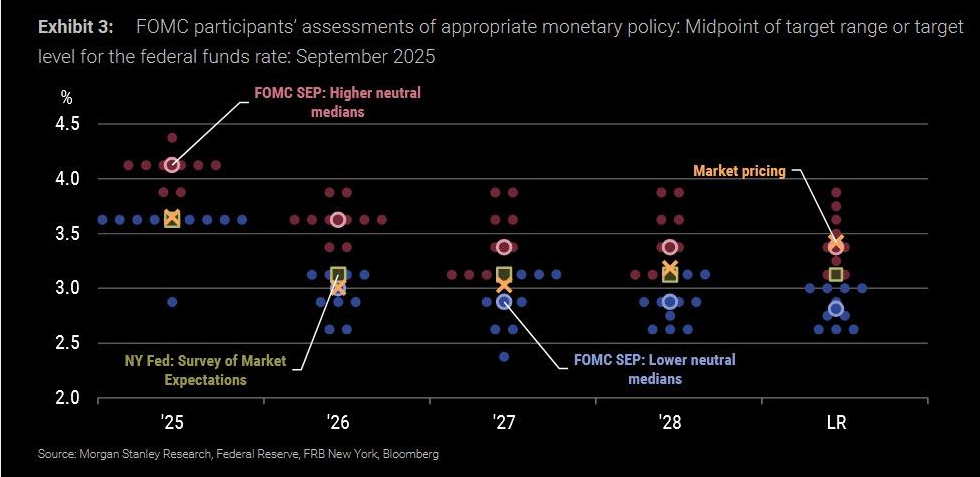
In its proposed dot plot, Morgan Stanley illustrates how the market prices in a path nearly identical to that expected by market participants and major dealers through 2028. Market prices closely align with participant expectations, with money market trading occurring at very low term premiums. This alignment explains the low realized volatility, as interest rate markets have been moving within a narrow range. It also indicates that if investor expectations shift sharply in either direction, the risk premium could amplify market movements, leading to higher realized volatility.
STATEMENT: According to a Bank of America warning, “pay attention to the language in the forward guidance.” The bank expects two or three significant changes in the FOMC statement. The description of the labor market is likely to omit the phrase that the unemployment rate “remains low,” reflecting the 32-basis-point increase over the past three months. The wording in the forward guidance may also be adjusted to indicate that the threshold for additional rate cuts has risen, signaling to the “hawks.”
One possibility is to add the word “any,” as in: “In considering any additional adjustments to the target range for the federal funds rate…”. A slightly more moderate alternative is to use “the extent and timing of” instead of “any,” returning to the language from earlier in the year, when the committee was on pause but still expected further cuts.
Goldman trader Shawn Tuteja notes that the consensus is for the statement to signal a pause in further cuts (after this meeting), unless labor market data deteriorates – consistent with changes in the statements from October 2019 and December 2024 (both being the third consecutive meetings with cuts, as is expected for the current one).
Below, Morgan Stanley provides a redline comparison showing how the FOMC statement might look.
Varchev Absolute Trader
борсова платформа
- Търгувай над 3000 финансови инструмента: Crypto, Форекс, Акции, Индекси, Суровини, ETF-и
- Използвай платформа с директно изпращане ордерите на борсите
- Cloud base платформа - твоят трейдинг сетъп на всяко устройство
- Market Sentiment - търгувай с настроенията на инвестиционите банки
- Top movers - най-горещите трейдове във всеки един момент
- Stocks scanner - филтрирай най-подходящите за твоя трейдинг стил пазарни инструменти
- Heat map - Търгувай в посоката на големите играчи
Meta Trader 5
- Търгувай Crypto, Форекс, Акции, Индекси, Суровини - всичко на едно място
- Автоматизирана търговия с интелигентни стратегии и роботи (Expert Advisors)
- Разширен технически анализ с хиляди индикатора и инструменти
- Сигурност и стабилност – платформа, доверена от милиони по света
- Нулев марджин при насрещни/хеджирани позиции
- Без комисиона при търговия със CFDs
- Светкавично изпълнение на сделките
Read more:

Login to comment
Comments:
Leave a comment