


Macroeconomics This Week Is Entirely Focused on Long-Term Interest Rates, according to Goldman Sachs macro traders Cosimo Codacci-Pisanelli and Rikin Shah.
Concerns about fiscal sustainability never completely go away, but with a decreasing likelihood of a recession, the market is once again turning its attention to these issues as Trump’s fiscal bill moves through Congress.
From a high-level perspective, while the bill doesn’t further increase the deficit (when offset against expected tariff revenues), it doesn’t show any ambition to reduce borrowing.
The tax cuts are slightly larger and more front-loaded than expected, and the spending cuts are more delayed over time.

This is enough to influence Moody’s decision to downgrade the U.S. rating, although we view it more as a symptom, not a cause, of the move in long-term yields. Alongside the publication of the bill details, there’s been a notable shift in tone from Treasury Secretary Bessent regarding fiscal consolidation — something he strongly supported earlier this year.

From plans for a 3% deficit to now blaming the previous administration for the starting point, and highlighting that not increasing the deficit is an achievement. Deficits around 7% seem likely to persist for now.
IT’S ALL ABOUT LONG-TERM RATES…
This comes as the U.S. faces the worst combination of growth and inflation among developed economies, and America’s exceptional status is weakening — making long-term rates and the dollar the “pressure relief valves.”
What could reverse the direction of long-term yields?
- Spending cuts – politically unpopular, as the administration seeks a pro-growth narrative.
- Intervention by the Fed or Treasury – possibly increasing bond buybacks at the next meeting, though not a tool for reducing equilibrium yields.
- Demand-side incentives – measures like deregulation (SLR) or tax cuts are already in place.
- Increased hedging value of U.S. Treasuries – which depends on improved correlations.
- A change in the macroeconomic outlook supporting rate increases.
Currently, none of these factors seem poised to offer meaningful support, so the upward trend in long-term yields may continue. The speed of this move is critical — low volatility has so far allowed a pause in the equity rally, but not sharp reversals. A more abrupt move could trigger market reactions and tighten financial conditions, acting as a “brake.”
But keep in mind, a continued weakening of the dollar could offset tighter financial conditions.
How High Can 30-Year U.S. Bonds Go?
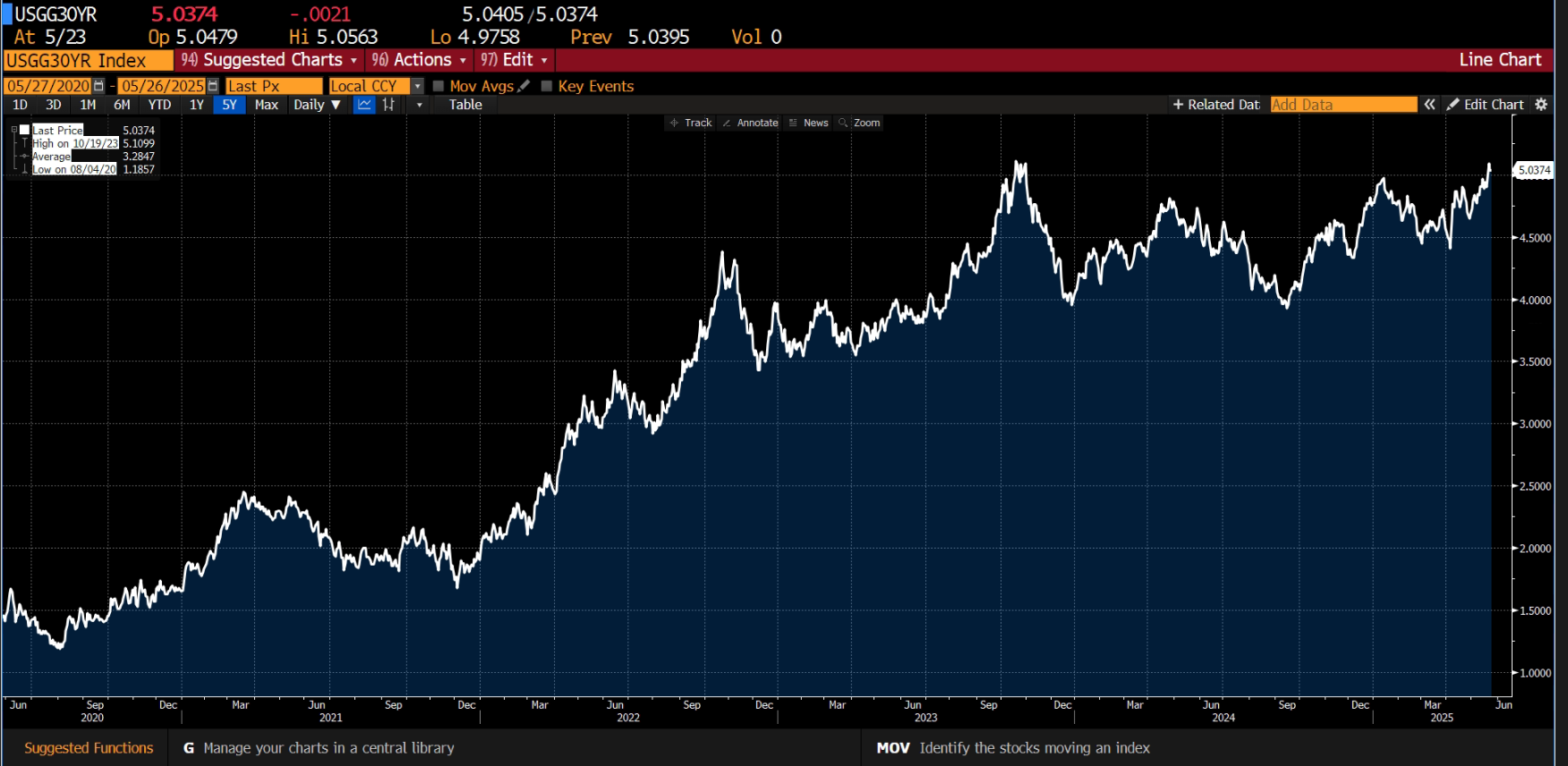
With growth trends of 2–2.5%, inflation around 3%, and a steady deficit near 7%, it’s easy to imagine 30-year bond yields closer to 6% than 5%.
30-year U.S. bond yields are set to break 5% for the first time since October 2023…

ECB’s June Rate Cut Is a Done Deal, and Trade Dispute Risks Are Rising, Hinting at More Cuts…
Weaker PMIs and significantly lower-than-expected wage growth supported the rate cut in June, while Trump’s proposal for a 50% tariff on the EU underscores the risks for further easing.
The drop in the composite PMI (by 0.9 to 49.5) was a surprise, as sentiment was expected to improve following the U.S.-China trade deal and rising stock markets. The significant decline in agreed wages for Q1 to 2.4% (down from 4.1% in Q4 2024 and less than half the peak a year ago) also added pressure.

Inflation estimates (GIRs) since early May were at 3–3.5%, already below ECB forecasts, so this result is a major miss and increases the risk of below-target inflation. The more dovish voices in the committee, especially Lane, will surely use this as justification to extend the easing cycle beyond June.
The most impactful event on short-term rate pricing this week was Trump’s comment signaling no progress in trade negotiations.
The 50% tariff proposal is extreme and appears aimed at pressuring the EU into further concessions, but it clearly raises the risk of adverse scenarios. The U.S. demands seem unfeasible for the EU, meaning the EU will likely respond with reciprocal tariffs, leading to retaliation.

The June meeting will bring expected downward revisions to growth and inflation forecasts, but with a 2% interest rate, a shift toward a more neutral stance wouldn’t be surprising. The base case remains a pause in July (9 bps priced in), surprisingly supported this week by even a known dove (Stournaras). A more aggressive path depends on persistent core inflation (expected to be 2.4% in Q4, up from 2.1% in ECB’s March projections) and diminishing global growth due to escalating trade war risks. But, as Trump showed this week, the risks of a negative outcome in EU–U.S. talks remain.

UNITED KINGDOM: THE LATEST INFLATION REPORT BOLSTERS THE HAWKS…
Services showed higher inflation in the UK this week – 5.4% vs. a 4.8% consensus and a 5% BoE forecast.
The favorable explanation was that much of this increase came from volatile components such as car registration fees, airline tickets, and holiday packages.

This means the BoE’s measure of core services inflation (excluding volatile/indexed components) is actually lower. While we agree with that assessment, it’s often easy — and sometimes dangerous — to strip out parts of inflation to produce a more favorable reading. Ultimately, this report will encourage Pill and the hawks on the committee to adopt a more cautious stance and put the burden of proof on the data to justify continued rate cuts. April’s wage data (the first of the new fiscal year), due mid-June, will be crucial. Wages remain elevated in absolute terms; further progress will build confidence for ongoing and possibly faster rate cuts — as Deputy Governor Lombardelli noted. GIR remains convinced that the recent wage momentum will continue and accelerate, surprising the BoE negatively.

This view is based on:
(i) the Q1 slowdown pace,
(ii) much lower real wage agreements than last year,
(iii) broad signs of labor market loosening,
(iv) DMP surveys showing lower expected wage growth.
But if there’s no progress in April’s wage data, August rate cut expectations will be questioned.
We recommend long positions in terminal rate trades in the UK, and while this inflation report somewhat undermines our view and leans the debate toward the hawks, we remain optimistic about market reaction post-publication. The short-term sell-off was limited, which — especially by UK standards — suggests that current pricing (about 60 bps terminal rate) offers an asymmetric opportunity favoring long positions. We still see value in holding longs at the short end with an option-like strategy.
WHERE IS THE DOMESTIC DEMAND FOR LONG-DATED JAPANESE BONDS?
Yields on 30-year Japanese bonds are already up 70 bps this year, and the 10s30s curve has steepened by 50 bps since early April. The trigger this week was another weak 20-year bond auction, showing the largest tail since 1987 (13.75 bps) and the lowest demand since 2012.
Varchev Absolute Trader
борсова платформа
- Търгувай над 3000 финансови инструмента: Crypto, Форекс, Акции, Индекси, Суровини, ETF-и
- Използвай платформа с директно изпращане ордерите на борсите
- Cloud base платформа - твоят трейдинг сетъп на всяко устройство
- Market Sentiment - търгувай с настроенията на инвестиционите банки
- Top movers - най-горещите трейдове във всеки един момент
- Stocks scanner - филтрирай най-подходящите за твоя трейдинг стил пазарни инструменти
- Heat map - Търгувай в посоката на големите играчи
Meta Trader 5
- Търгувай Crypto, Форекс, Акции, Индекси, Суровини - всичко на едно място
- Автоматизирана търговия с интелигентни стратегии и роботи (Expert Advisors)
- Разширен технически анализ с хиляди индикатора и инструменти
- Сигурност и стабилност – платформа, доверена от милиони по света
- Нулев марджин при насрещни/хеджирани позиции
- Без комисиона при търговия със CFDs
- Светкавично изпълнение на сделките
Read more:


Login to comment
Comments:
Leave a comment