


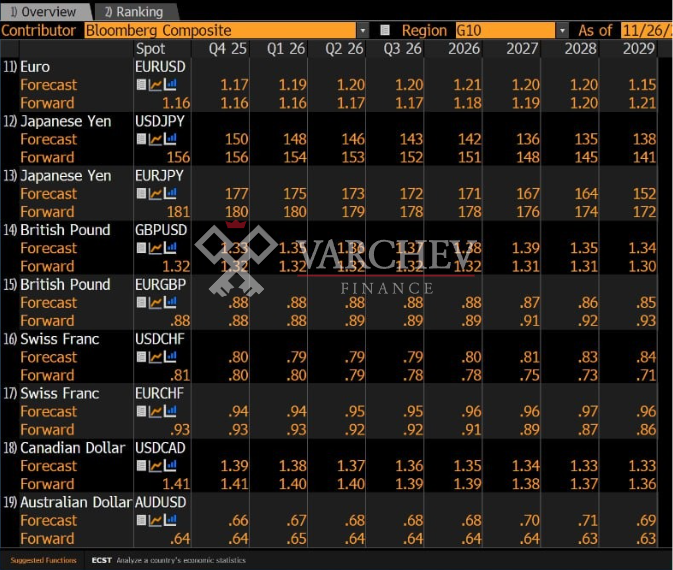
Today, we are witnessing in real time the decline of fiat currencies in developed economies. The global reserve system is slowly but decisively diversifying from a model based entirely on fiat money to a hybrid regime where gold, rather than fiat currency, plays a dominant role.
IMF COFER data show that although the US dollar still dominates, its share of reported reserves is gradually falling toward the high 50% range. For the first time in 40 years, gold has surpassed both the US dollar and the euro as the primary asset in central bank portfolios.
There is a reason for this historic shift. Developed economies have exceeded all reasonable debt limits.
Government debt represents the issuance of currency, and trust in developed countries as issuers is eroding rapidly. This began when the ECB, the Federal Reserve, and other major central banks reported significant losses. Their assets yielded negative returns while inflation and solvency concerns became evident. Leading economists and governments downplayed these losses, but they exposed the high risk inherent in asset purchases made in previous years.
Inflation represents a form of gradual de facto default on existing obligations, and global central banks are shying away from developed-country debt because they see a worsening fiscal and inflationary outlook. Government debt is no longer considered a reliable reserve asset.
Global public debt has reached around $102 trillion—a new historic record—well above pre-pandemic levels and close to the peaks seen during the most aggressive monetary expansions. Government debt drives this phenomenal growth, with countries like France and the United States maintaining huge annual deficits even in periods without crises. The Biden administration’s policies in the US are the clearest evidence of unchecked fiscal policy—record deficits and spending increases of more than $2 trillion during a period of strong economic recovery.
How did this loss of trust happen? States with monetary sovereignty do not have unlimited capacity to issue currency and debt. They face clear limits, the crossing of which leads to an immediate loss of global confidence. Developed economies have breached all three limits, especially since 2021:
Economic limit is reached when rising debt leads to declining marginal growth. Government spending artificially inflates GDP, but productivity stagnates, and real net wages are stagnant or falling.
Fiscal limit occurs when rising interest and social spending displace productive investment. Despite financial repression, low interest rates, and monetary stimulus, interest payments consume an increasing share of developed-country budgets, making debt financing more expensive even when annual CPI inflation declines.
Inflationary limit is reached when repeated monetary financing of government spending undermines confidence in the purchasing power of fiat currency, and accumulated inflation outpaces real wage growth, causing an affordability crisis.
The recent combination of high nominal debt, rising interest costs, and structural fiscal deficits in major developed economies shows that all limits have now been exceeded.
Central banks fully understand the nature of fiat money and recognize that government debt is no longer the safe asset that provides stability and real returns. That is why they have responded with an unprecedented wave of gold purchases. Net official purchases exceeded 1,100 tons in 2022 and remained above 1,000 tons in 2023 and 2024—more than twice the annual average from 2010–2021. In 2024, central banks officially acquired 1,045 tons of gold, marking a third consecutive year above 1,000 tons and extending a 15-year streak of net increases. Unofficial purchases are believed to be significantly higher. Surveys indicate that about one-third of central banks worldwide plan to increase their gold reserves in the coming years, and over four-fifths expect global official gold reserves to continue rising due to concerns over persistent inflation, financial stability risks, and solvency issues.
Record demand for gold is a direct response to the lack of confidence in the sustainability of fiat obligations issued by over-indebted states. Gold carries no default risk and is not controlled by central banks, making it a suitable asset at a time when central banks themselves question the long-term reliability of major currencies.
Many reserve managers believe that the way governments expand money supply during crises and then slowly return to normal policies means that inflation and financial control are now permanent features of the system rather than temporary fixes. This is why gold purchases serve as insurance against the gradual taxation of savers through negative real yields and inflation.
This does not imply the inevitable collapse of the US dollar or a process of dedollarization, but an unmistakable loss of confidence in all fiat currencies—from the euro and pound to the yen and dollar. The US dollar remains the leading fiat currency, representing 89% of global transactions and 57% of world reserves. Yet it leads a declining order based on money without backing.
Investors and central banks are moving toward a hybrid reserve model in which fiat currencies exist alongside a sustainably higher share of gold and increasing use of decentralized cryptocurrencies.
Some central banks are reacting in panic. The ECB seeks to enforce euro usage through the introduction of a central bank digital currency, reflecting both desperation and a desire for control. The Federal Reserve and US government are encouraging the use of bond-backed stablecoins as a way to support dollar demand. This appears preferable to coercive measures, especially as the US focuses on reducing deficits and debt. Nevertheless, if the US government does not accelerate actions to limit debt through growth policies and spending cuts, confidence in the currency could quickly weaken.
No government in developed economies wants to reduce spending, except perhaps the US administration, which does so only moderately despite evidence of declining solvency trust. With government debt above 100% of GDP, persistent primary deficits, and political resistance to serious budget cuts, fiat currency issuers are likely trapped beyond economic, fiscal, and inflationary limits.
We live in a period of historic monetary change with long-term consequences. Global central banks no longer trust paper promises and are seeking real money. The first country to adopt stable monetary and fiscal policies will win. All others will lose.
Varchev Absolute Trader
борсова платформа
- Търгувай над 3000 финансови инструмента: Crypto, Форекс, Акции, Индекси, Суровини, ETF-и
- Използвай платформа с директно изпращане ордерите на борсите
- Cloud base платформа - твоят трейдинг сетъп на всяко устройство
- Market Sentiment - търгувай с настроенията на инвестиционите банки
- Top movers - най-горещите трейдове във всеки един момент
- Stocks scanner - филтрирай най-подходящите за твоя трейдинг стил пазарни инструменти
- Heat map - Търгувай в посоката на големите играчи
Meta Trader 5
- Търгувай Crypto, Форекс, Акции, Индекси, Суровини - всичко на едно място
- Автоматизирана търговия с интелигентни стратегии и роботи (Expert Advisors)
- Разширен технически анализ с хиляди индикатора и инструменти
- Сигурност и стабилност – платформа, доверена от милиони по света
- Нулев марджин при насрещни/хеджирани позиции
- Без комисиона при търговия със CFDs
- Светкавично изпълнение на сделките
Read more:

Login to comment
Comments:
Leave a comment