


Here are five key things investors are watching at the start of the trading day:
1. Inflation offers some relief
While investors are feeling a degree of relief amid easing geopolitical and trade tensions, yesterday’s inflation data provided an additional calming signal. The figures came in line with expectations, although they remain above the level the Federal Reserve considers healthy.
Headline and so-called “core” readings of the Personal Consumption Expenditures index for November stood at 2.8%, matching economists’ forecasts. Nevertheless, the Fed’s preferred inflation gauge indicates that price pressures remain meaningfully above the 2% target.
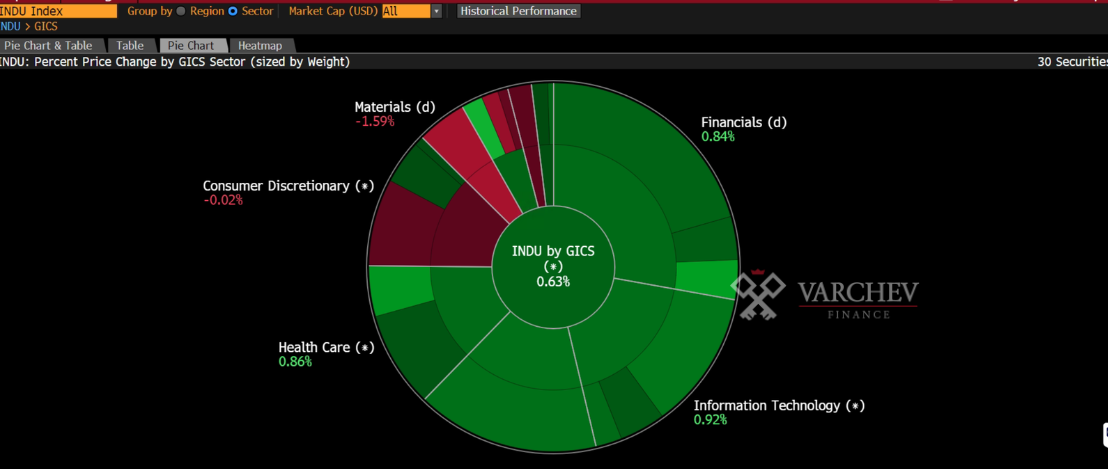
Stocks rose for a second consecutive day, extending the recovery that began after President Donald Trump scrapped planned tariffs on some European countries and announced a “framework for a future agreement on Greenland.” However, premarket trading today remains hesitant about how the session will begin. The Dow Jones Industrial Average is up more than 300 points and has moved into positive territory for the week, reversing Tuesday’s sell-off. The S&P 500 and the Nasdaq Composite, however, are still on track to end the period lower.
Retail investors continue to buy actively despite elevated volatility, once again showing a tendency to step in during pullbacks. At the same time, U.S. equity futures are slightly lower this morning, suggesting a possible pause after the two-day rebound.
2. Banks and the courts
President Donald Trump is launching a lawsuit against JPMorgan Chase and the bank’s CEO, Jamie Dimon.
In the lawsuit filed in Florida, Trump claims that the closure of his and related accounts in early 2021 was politically motivated. The president says Dimon “cut him off from the banking system” and is seeking at least USD 5 billion in damages.
JPMorgan says the account closures followed the events of January 6, 2021, and Trump’s departure from the White House. The bank states that it considers the lawsuit to be without merit.
3. Disappointment around Intel
Intel beat Wall Street expectations for the fourth quarter, but a weaker outlook for the current period led to a roughly 13% drop in the stock in after-hours trading.
Chief Financial Officer David Zinsner explained that the softer guidance is partly due to supply constraints. According to him, Intel does not have sufficient capacity to meet seasonal demand this quarter, but conditions are expected to improve over the next three months.
The pullback comes after a strong rally, with Intel shares up nearly 150% over the past 12 months, supported by investments from the U.S. government, SoftBank, and Nvidia.
4. TikTok remains in the U.S.
TikTok announced that it has officially established a joint venture that will allow it to continue operating in the United States. A law passed in 2024 would have effectively banned the platform unless its Chinese parent company, ByteDance, divested its U.S. business.
The new entity will operate as an independent structure and will be led by Adam Presser, TikTok’s head of Operations, Trust, and Safety. Americans will hold the majority of seats on the board of directors.
Despite uncertainty about its future, TikTok remains among the most popular apps in the U.S. and was the second most downloaded app in both the App Store and Google Play in 2025.
5. Tensions around Greenland persist
After Trump announced that he had reached a “framework” for an agreement with NATO regarding Greenland, European leaders are seeking greater clarity.
MEP Bernd Lange said the European Union needs more transparency, as details of the arrangement remain unclear. Greenland’s Prime Minister, Jens-Frederik Nielsen, also noted that he does not know the specifics, but emphasized that the island’s sovereignty and territorial integrity are “red lines.”
Ukrainian President Volodymyr Zelensky criticized European leaders in a speech in Davos, saying Europe appears hesitant and unfocused at a time when it should take a leading role in defending freedom.
U.S. indices
U.S. equity futures are edging slightly lower after the main benchmarks posted two consecutive sessions of gains amid easing geopolitical concerns.
Dow Jones futures are down about 161 points, or 0.3%. Contracts on the S&P 500 are lower by 0.1%, while Nasdaq-100 futures are down 0.2%.
Shares of Nvidia and Advanced Micro Devices are up more than 1% and around 3%, respectively, in early trading. The move follows reports cited by CNBC that Nvidia CEO Jensen Huang plans to visit China in the coming days.
By contrast, Intel shares are down around 13% after the company delivered a disappointing forecast for the first quarter.
Wall Street’s major indices rose for a second straight session as investors responded positively to signs of easing trade tensions and geopolitical risk. The Dow Jones gained more than 300 points, or 0.6%, the S&P 500 added about 0.6%, and the tech-heavy Nasdaq Composite climbed 0.9%. The small-cap Russell 2000 index closed at a record high.
Markets began their recovery on Wednesday after U.S. President Donald Trump abandoned planned tariffs on imports from eight European countries that were due to take effect on February 1. The decision followed an announcement that Trump and NATO Secretary General Mark Rutte had reached a “framework for a future agreement” regarding Greenland.
Earlier, Trump also told CNBC that there was a “concept of a deal” with the Arctic island. At the same time, Greenland’s Prime Minister Jens-Frederik Nielsen said he was not aware of the details of the announced framework and stressed that Greenland’s sovereignty and territorial integrity are red lines.
“Details around the agreement remain unclear and geopolitical tensions around the island could re-emerge, but investors are reacting with relief to the rapid progress toward a deal after the severe market turbulence earlier in the week,” said James McCann, senior economist at Edward Jones.
He also pointed to gains in gold, with futures on the precious metal closing at a new record.
“What’s interesting is that despite the recovery in risk assets, gold is holding on to most of its recent gains. This confirms the metal’s strong trend amid rising geopolitical uncertainty, concerns over the long-term state of U.S. public finances, and increasing political pressure on the Federal Reserve,” McCann added.
Gains on Wednesday and Thursday offset earlier losses for the Dow Jones this week, leaving the index up just under 0.1% since Monday. At the same time, the S&P 500 and Nasdaq are on track to post a second consecutive weekly decline, down about 0.4% and 0.3%, respectively.
What investors should do in an environment of uncertainty
Markets are entering a phase of heightened sensitivity, but this is precisely what creates opportunities for well-prepared investors. Recent Wall Street sessions clearly show a distinction between short-term relief and deeper structural risks, opening up different possible courses of action.
On one hand, equities are rebounding as geopolitical tensions ease. The cancellation of planned tariffs and signals of diplomatic progress are restoring risk appetite, with major indices posting strong gains and segments such as technology and small-cap stocks even reaching record levels. In such an environment, short-term strategies can focus on stocks with clear momentum, particularly in sectors that react quickly to news, such as semiconductors, artificial intelligence, and cyclical industries.
At the same time, markets clearly show that uncertainty has not disappeared. Futures remain choppy, and investors are cautious given the unclear details around political agreements, inflationary pressures, and future central bank actions. This suggests that volatility will persist and continue to create opportunities to buy on pullbacks.
Intel’s weak guidance is a clear example of why asset selection is more important than ever. Despite the broader market rally, individual companies can come under significant pressure due to fundamental factors. This points investors toward better-diversified portfolios and toward combining growth stocks with more defensive instruments.
Gold’s behavior is a key signal. Despite the rebound in risk assets, the precious metal remains near record levels. This indicates that markets are still seeking protection against geopolitical shocks, fiscal risks, and political pressure on monetary policy. For investors, this means that a balanced approach with exposure to defensive assets may be a sensible strategy in the coming months.
In summary, the current market environment will reward flexible strategies. Short-term traders can take advantage of sharp moves and news flow, while long-term investors will look for quality assets on pullbacks and focus on diversification across equities, commodities, and more conservative instruments. Markets will continue to react strongly to every new piece of information, and that is precisely what creates opportunities for those who are prepared and act with discipline.
Varchev Absolute Trader
борсова платформа
- Търгувай над 3000 финансови инструмента: Crypto, Форекс, Акции, Индекси, Суровини, ETF-и
- Използвай платформа с директно изпращане ордерите на борсите
- Cloud base платформа - твоят трейдинг сетъп на всяко устройство
- Market Sentiment - търгувай с настроенията на инвестиционите банки
- Top movers - най-горещите трейдове във всеки един момент
- Stocks scanner - филтрирай най-подходящите за твоя трейдинг стил пазарни инструменти
- Heat map - Търгувай в посоката на големите играчи
Meta Trader 5
- Търгувай Crypto, Форекс, Акции, Индекси, Суровини - всичко на едно място
- Автоматизирана търговия с интелигентни стратегии и роботи (Expert Advisors)
- Разширен технически анализ с хиляди индикатора и инструменти
- Сигурност и стабилност – платформа, доверена от милиони по света
- Нулев марджин при насрещни/хеджирани позиции
- Без комисиона при търговия със CFDs
- Светкавично изпълнение на сделките
Read more:

Login to comment
Comments:
Leave a comment